Heads up! This article was written before Webiny 6.0 was released and may contain outdated information.

Swapnil M Mane
Heads up! This article was written before Webiny 6.0 was released and may contain outdated information.
Webiny is the AI-programmable CMS that gives enterprises full control. Build, extend and automate your content operations with a platform designed to be shaped by both developers and AI agents.
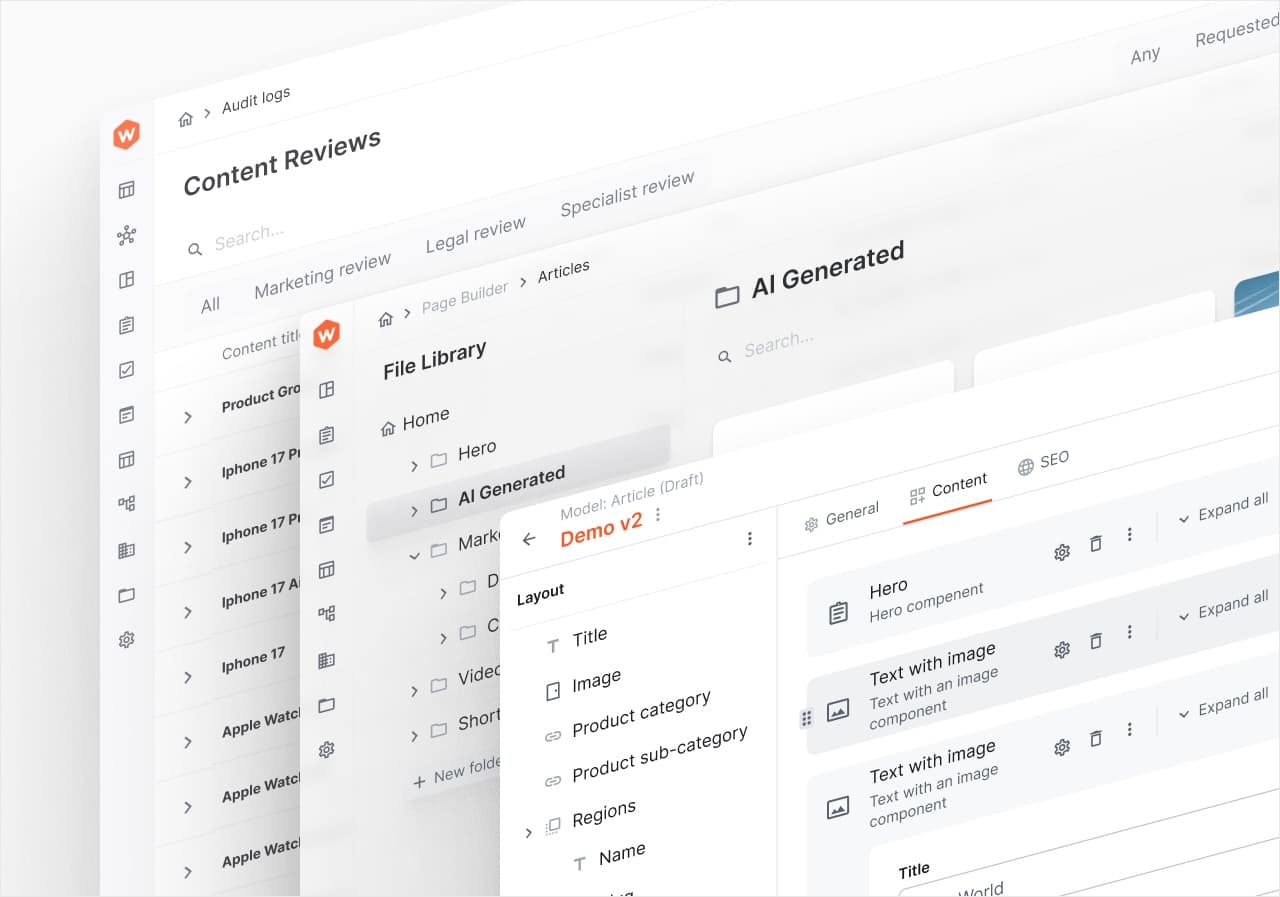
Composable architecture is a way of building applications using modular, interchangeable components—much like Lego blocks. Each component is self-contained and can be rearranged or replaced independently, allowing for greater agility and customization.
Traditional architectures are tightly coupled systems where all functions live within a single codebase. Composable architectures, by contrast, are built from loosely coupled components (often microservices), which can be independently developed, deployed, and scaled.
Not exactly. While composable architectures use microservices as building blocks, composability extends beyond just software—it includes infrastructure, APIs, third-party tools, and even business processes. Microservices are a part of composability, but not the whole story.
Key benefits include faster innovation, independent scalability, easier maintenance, enhanced flexibility, and the ability to customize and future-proof your systems.
Challenges include managing complexity, ensuring security across many APIs, monitoring distributed systems, and making necessary organizational changes to adopt a modular mindset.
It’s ideal for businesses looking to scale quickly, innovate faster, support omnichannel experiences, or break down monolithic systems for better agility. Industries like e-commerce, tech, finance, and healthcare can particularly benefit.
Yes. Its modular nature allows businesses to swap out outdated components without overhauling the entire system. This adaptability ensures long-term sustainability as technology and business needs evolve.
In the digital age, which is as dynamic and ever-shifting as a bustling metropolis, speed, agility, and adaptability are no longer just desirable — they are critical. Traditional software development approaches fail to keep pace with this relentless activity. They often result in rigid, monolithic systems that can’t quickly adapt to evolving business architecture needs or market demands.
To address the limitations of traditional software, an increasing number of businesses are turning to composable technologies. Instead of building giant monoliths, composable solutions focus on creating systems using discrete, interchangeable building blocks. These building blocks can be dynamically orchestrated and rearranged to meet the unique and changing requirements of modern businesses.
In the following sections, we will explore composable architecture in more detail, covering its core characteristics, benefits, and challenges and comparing it with microservices and traditional architectures.
At its core, composable architecture is an approach to designing and building applications by assembling independent, self-contained, and interchangeable components. Each component serves a specific purpose and has well-defined boundaries.
The easiest way to visualize a composable application architecture is to think of it as a Lego set. Just like you can assemble and rearrange Lego bricks to construct various structures, you can put together composable architecture components in countless configurations to create diverse and dynamic applications.
This is in sharp contrast to traditional or monolithic architectures, in which the entire application is represented by one large, all-encompassing monolith. Changes made to one part of the application can cascade through the whole system, making monolithic applications inherently inflexible.
Composable application architectures, however, foster a “loose coupling” of smaller, agile components. This ensures that changes in one component have minimal, if any, impact on others, making composable technologies more flexible and easier to maintain.
MACH stands for Microservices, API-first (application programming interfaces), Cloud Native and Headless. It is a set of principles that play a crucial role in enabling composability:
One example of a composable architecture in action is Webiny, an open-source headless Content Management System (CMS). Since Webiny is API-first, developers can use the same headless backend instance to fetch content for all digital channels, using their preferred frontend tech stack.
It’s also a cloud-native platform that runs on AWS’s serverless offerings and streamlines integration with other cloud services. Another aspect of its composability is that you can use Pulumi IaC to dynamically adapt your infrastructure as and when needed.
As mentioned above, traditional and composable architectures are fundamentally different. In the following subsections, we will delve deeper into their differences.
In a traditional architecture, applications are structured as monolithic entities. This means that all functionalities of a system, including user interface, database integrations, payment processing, caching, searching and more, are encapsulated within a single application.
Here are some core characteristics of a monolithic architecture:
In contrast, a composable approach promotes modularity and flexibility. They focus on building a composable system with interchangeable, loosely coupled components (microservices) that can be dynamically orchestrated. This means that there may be a separate microservice for each core functionality, including user interface, database integration, authentication and logging.
Here are some core characteristics of composable architectures:
Here’s a comparison table that summarizes the main differences between composable and traditional architectures:

While microservices are fundamental building blocks of composable architectures, they are also a distinct architectural approach in themselves.
This means that even though all composable architectures leverage microservices, not all microservices implementations necessarily lead to a fully composable architecture. In the following sections, let’s explore these nuances in more detail.
In a microservices architecture, each microservice acts as an autonomous and self-contained unit responsible for a specific business capability. Some key characteristics of microservices include:
Now, let’s explore the similarities and differences between microservices and composable services.
Microservices architecture: Focuses on dividing applications into small, independent services.
Composable architecture: Applies modularity to a broader range of business and technology components, including infrastructure and third-party solutions.
Microservices architecture: Primarily a software development approach.
Composable architecture: Encompasses a broader organizational strategy, including business processes, technology infrastructure and data management, beyond just software development.
Both: Use APIs for integration.
Composable architecture: Implements a higher level of interoperability across several business architecture components, including software, data sources and operational processes. This enables them to be easily assembled and reconfigured to meet changing needs.
Microservices architecture: It can get hard to manage a large number of independent services, especially for understaffed development teams.
Composable architecture: Even more complexity is added to the overall system when you are managing a wider range of services that includes non-software components.
Both: Aim to increase flexibility and agility through modularity and independent operability.
Composable architecture: Goes beyond software adaptability and strives for “business agility”. A composable architecture makes it possible to adapt business processes, data and other components to changing market demands.
Here are some more benefits of composable architecture:
Even though composable architectures promises several benefits, there are a few challenges and considerations that businesses should be aware of:
Composable business solutions have wide-ranging use cases. Let’s explore how they can benefit businesses across various industries:
The future belongs to composability, where businesses increasingly leverage independent, reusable components to build adaptable and agile applications. This shift will not only revolutionize how organizations function but also reshape the entire technology ecosystem.
As the demand for composable business solutions grows, technology providers are expected to adapt their offerings. Gartner predicts that by 2026, the top 20 cloud services and SAAS vendors will offer “component marketplaces” to support the “composable strategies” of their customers.
Other insightful predictions from Gartner include:
As we move forward, the software landscape will inevitably become more interconnected and interoperable. Businesses will be able to mix and match components from different vendors to create bespoke solutions at will. Today, this level of flexibility and customisation requires substantial engineering effort and cost. However, as composable business architectures gain traction, they should become more and more accessible.
Composable architectures are ideal for modern businesses aiming to meet dynamic market demands and customer expectations through digital transformation. They boost collaboration, productivity and agility, all while being inherently more scalable and cost-effective.
However, before you build or transition to composable software, it’s important to consider potential implications related to security, governance and organizational change management.
Webiny's open-source, headless CMS+ is here to support you on your journey towards a composable approach across digital channels. Click here to learn more about Webiny today.