Headless content management systems (CMSs) afford modern businesses the agility and flexibility they need to survive today’s competitive digital landscape. By decoupling the frontend from the backend, a headless CMS enables your marketers and developers to work independently of each other and simplifies the process of expanding to new digital frontiers.
Strapi and Contentful, two titans of the headless CMS realm, have long dominated the scene. However, a new contender, Webiny, is steadily gaining momentum and posing a formidable challenge to the established duo.
In this comprehensive analysis, we will perform a comparative study of Strapi and Contentful across several key areas that include: ease of use, customisability, performance, scalability, community, and support. We will also introduce Webiny and explore its unique value proposition.
Overview of Strapi
Strapi is an open-source headless CMS built using JavaScript/TypeScript. It can be self-hosted inside your own setup or deployed within the fully managed Strapi cloud.
Strapi simplifies the process of defining a dynamic content structure and leveraging it to deliver rich omnichannel experiences. The intuitive content types builder enables marketers to define customisable content layouts. Seamless, API-driven interoperability empowers developers to consume the content using the frontend platforms they feel most comfortable with.
Other useful Strapi features include a dedicated asset library, support for multiple databases, strong authentication, role-based access control, auto-generated documentation, built-in localisation, and custom fields.
Strapi is a good fit for businesses of all sizes. If yours is a small company with a limited budget, you can opt for the self-hosted community plan, which is free forever. For larger organisations, Strapi offers tailored enterprise plans for both self-hosted and cloud-based segments.
Overview of Contentful
Contentful is a composable content management platform with an extensive feature set. It’s a fully managed, proprietary solution that offers much more than a typical headless CMS.
At the heart of Contentful lies the Contentful Studio, an intuitive and customisable application that catalyses the development of reusable content components and editing interfaces. It is packed with numerous tools to boost collaboration, including workflows, team presence, and scheduled publishing.
Other notable Contentful features include a visual modeller, an AI-powered content types generator, starter templates for many frontend technologies, an app framework for extensibility, live preview, and built-in localisation.
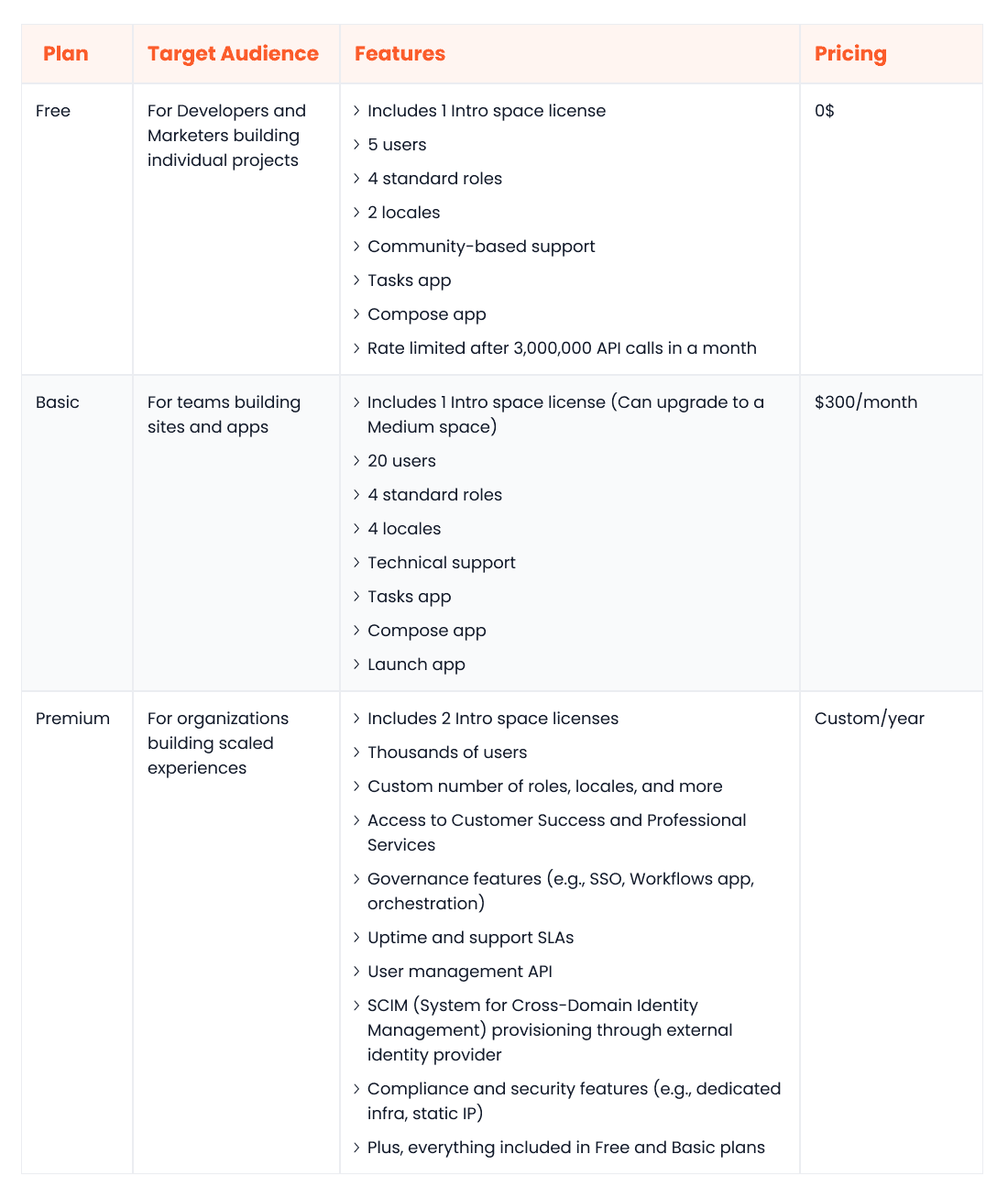
Contentful offers free and paid plans to cater to businesses of all scales. Although limited to 5 users and 1 space, the free plan is a good starting point for individual projects. Larger organisations can choose the premium plan, which offers the flexibility to choose a custom number of users and spaces.
Picking the right CMS: the criteria you should be using
Strapi and Contentful are top headless CMS solutions that accommodate diverse business needs. In the following sections, we will conduct a detailed comparison of these platforms, which will help you choose the optimal fit for your organisation.
Ease of use
Strapi
Strapi has an intuitive, easy-to-use interface for content modelling and creation. It offers business teams a straightforward way to define single types, collection types, custom fields and more. The editing experience is customisable as per the unique needs of your content creators.
Strapi also has several developer-centric features, including multi-database support (MySQL, Postgres, MariaDB, and SQLite), webhooks, the flexibility to choose between REST and GraphQL, and starter kits for many front-end technologies.
Contentful
Contentful places a strong emphasis on usability. The Contentful Studio provides a visual interface that empowers users to craft immersive omnichannel digital experiences. The AI-powered features for content and image generation enhance convenience and efficiency.
Contentful is also regarded as a developer-friendly platform. It offers starter kits, a dedicated developer portal, and extensive documentation to make it easier to get started. It uses REST and GraphQL APIs to address different use cases, including images, content delivery, content management, and preview.
Data query and content modelling
Strapi
Strapi helps you build a flexible and composable content model that is easy to scale. Regarding data querying, Strapi’s GraphQL API has built-in filtering, sorting, and pagination support. It also offers a Query Engine API to query the database with greater precision.
Contentful
Contentful users can also build highly customisable content models using as many custom fields and types as required. The GraphQL API makes it possible to perform filtered, sorted and ordered retrievals from the content repository.
Customizability
Strapi
As Strapi is open-source, you can fetch its source code from GitHub and customise it to your liking. The Strapi docs offer detailed tutorials on tailoring the admin panel, query engine, middleware, services, APIs, etc, to fit your business needs better. Moreover, the Strapi marketplace is home to several plugins that enable even non-technical teams to extend the core feature set.
Contentful
Being a proprietary solution, Contentful doesn’t allow any backend customisation. This means that you can’t change any core functionality of the platform. Even though the Contentful UI is mainly pre-configured, the Contentful Studio offers customisation options to content creators and marketers.
Performance and scalability
Strapi
The performance and scalability of self-hosted Strapi apps depend on the underlying infrastructure. However, the Strapi Cloud is purpose-built to manage substantial traffic loads. It leverages a fine-tuned infrastructure and CDN caching to deliver increased levels of performance, scalability, and resilience.
Contentful
Contentful outranks Strapi when considering performance and scalability due to its mature, cloud-native architecture. It leverages advanced caching, auto-scalable and self-healing Kubernetes clusters, a dual CDN approach, and a multi-region delivery infrastructure (MRDI) to ensure robust and efficient content delivery across the globe.
Integration ecosystem
Strapi
Strapi has a rapidly growing marketplace where you can find plugins for different use cases, ranging from SEO to productivity. It also offers several resources and documentation to help you build custom plugins.
Contentful
Contentful boasts a more mature and comprehensive integration ecosystem compared to Strapi. You can find plugins and apps across a broader range of categories on the marketplace, including SEO, analytics, commerce, and editing. Moreover, you can leverage the app framework to build your own apps to extend functionality.
Community and support
Strapi
Strapi features an active community of developers and users available on Discord and the official forums. On the official website, you will find a featured course, extensive documentation, and tutorials to help you familiarise yourself with the platform. Strapi only offers technical support (SLAs included) to its enterprise customers.
Contentful
Contentful has a well-established and thriving community. Whether you're seeking advice, troubleshooting issues, or exploring new features, you can connect with the community through the active Discord server or the forums on the official website. Additionally, the website provides access to tutorials, explainer videos, comprehensive documentation, and a regularly updated changelog. Contentful only offers technical support to paid plan users.
Open-source
Strapi
Strapi is available as open-source under the MIT license. This means you can directly access and tweak the source code as needed. Whether you want to rewrite the querying layer, extend the API, implement a new searching feature, or redesign the UI, Strapi’s open-source nature grants you the flexibility to do so.
Moreover, if you choose to self-host Strapi, you get complete control over several key aspects, including how your data is stored and secured and which CDN you use for content delivery.
Contentful
Contentful is a fully managed, closed-source SAAS CMS, meaning you can’t access its source code. Additionally, since you don’t have the option to self-host, you can’t store, secure, manage, and deliver data on your terms.
Pricing
Strapi
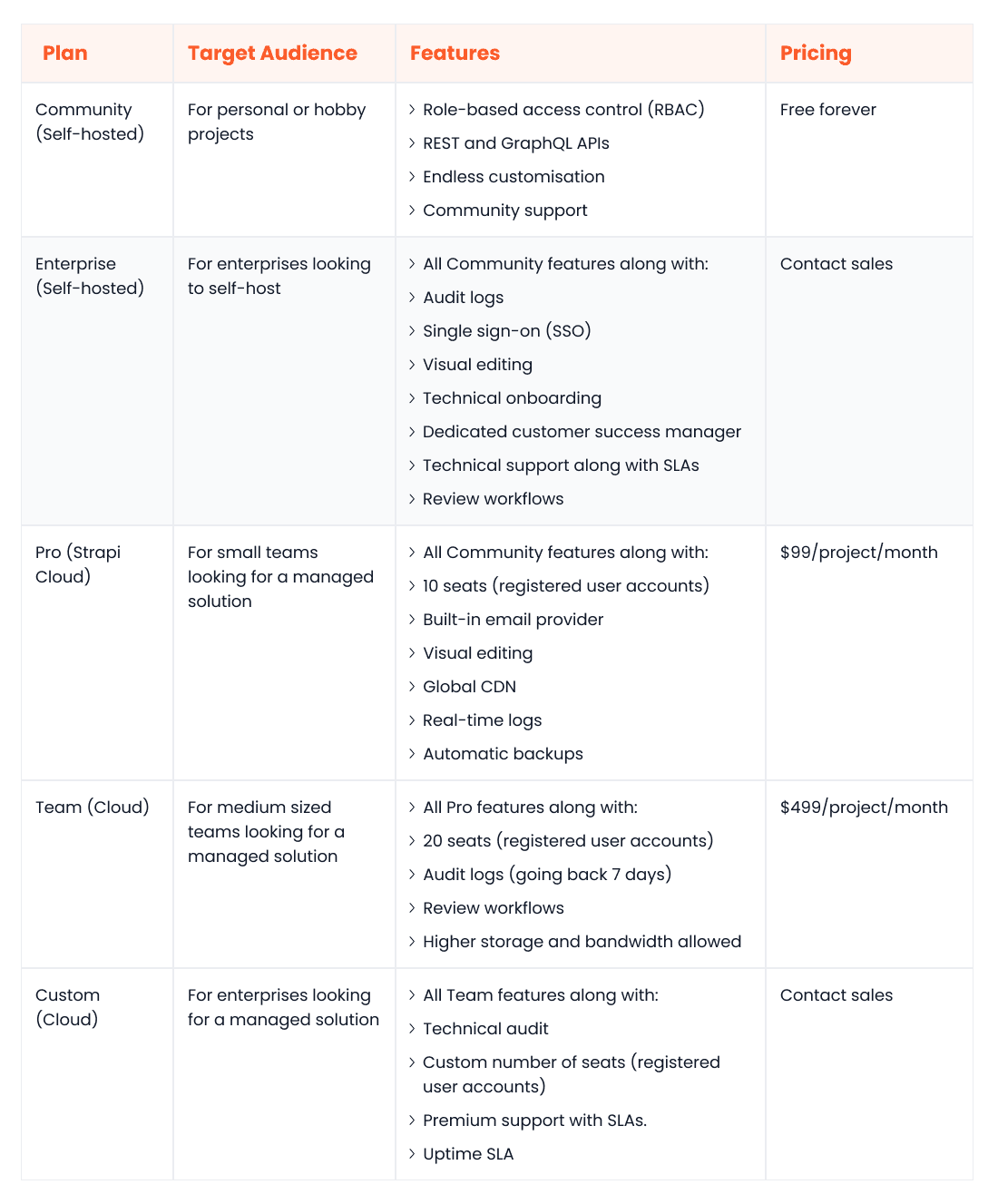
Strapi offers multiple self-hosted and managed (cloud) plans. The Community plan in the self-hosted category is free; it targets small businesses and individual projects. The Enterprise plan for self-hosted customers targets larger teams; contact sales at Strapi for pricing.
The Pro Plan in the cloud category is priced at $99/project/month; it caters to small businesses. The Team Cloud plan costs $499/project/month and targets medium-to-large companies. The Custom Cloud plan offers enterprise customers the most extensive feature set; contact sales at Strapi for pricing.
Here’s a comprehensive breakdown of Strapi’s pricing: