Contentful caps organizations at 750 spaces. Strapi's own documentation recommends running one instance per tenant, which means thousands of separate Node.js processes and databases if you're operating at that scale. If you're evaluating CMS platforms for an enterprise running dozens of brands, regional sites, or business unit properties, those two facts tell you the "best omnichannel CMS" listicles are answering a different question than the one you're asking.
Most of those lists rank on API surface area and channel count. That framing works fine for a single brand pushing content to a website, mobile app, and a smartwatch. It falls apart the moment each property is itself a channel, and at enterprise scale, that's the actual shape of the problem.
This piece defines the criteria that matter for omnichannel at scale, then evaluates the leading platforms against them. Multi-tenancy is one criterion among several, but it's the axis most comparisons skip.
What "omnichannel at enterprise scale" actually requires
Six criteria, each checkable against public documentation.
1. Channel breadth beyond web and mobile
Omnichannel touchpoints span at least seven categories: website content, mobile app content, email and newsletter content, social media content, in-store or kiosk displays, voice and conversational interfaces, and partner or syndication feeds. A CMS that treats "headless" as "we have a REST API" satisfies the first two. Enterprise omnichannel requires the delivery layer to hold up under all seven, with a query model flexible enough that consuming teams aren't blocked waiting on schema changes.
2. Tenant isolation as a first-class primitive
At enterprise scale, "multi-site" and "multi-tenant" are not the same thing. Multi-site means many properties sharing one content pool with folder-level separation. Multi-tenant means logical separation where brands, regions, or business units share one platform instance but have isolated content, permissions, and governance, with no cross-tenant leakage by default. The distinction matters because platform sprawl, one CMS instance per brand, is the failure mode multi-tenancy exists to prevent.
3. Programmatic tenant provisioning
If provisioning a new tenant requires clicking through an admin UI, you don't have an enterprise solution. You have a bottleneck. The criterion here is an API that lets you spin up a tenant, seed it with content models, apply templates, and configure permissions without human intervention. Any organization running more than roughly 20 properties needs this.
4. Governance that scales with the org chart
Role-based access control, approval workflows, and full audit logs need to work per tenant and across tenants. Central brand teams need read access across everything; regional teams need write access only to their tenant; legal needs an audit trail that follows a piece of content across every property that syndicated it. Security baselines, encryption at rest and in transit, ISO 27001, data residency controls, are table stakes but worth checking.
5. Economic model that doesn't punish scale
Some platforms price tenant isolation as a premium SKU. Each additional Sanity dataset costs $999/month beyond the two included on the Growth plan. Contentful spaces are the isolation unit, and multi-space architectures at enterprise price points become financially prohibitive quickly. The criterion isn't "cheapest." It's whether the pricing curve stays sane as tenant count grows into the hundreds.
6. Deployment control
Enterprises with data residency, compliance, or existing cloud commitments need self-hosting. SaaS-only platforms fail this test regardless of how strong the other criteria look. The right question is whether you can run the platform inside your own AWS account, VPC, or a Kubernetes cluster on infrastructure you already own.
How the platforms hold up
Ranked on the six criteria above. Every claim traces to public documentation; where a competitor's behavior has changed recently, verify against their current docs.
1. Webiny
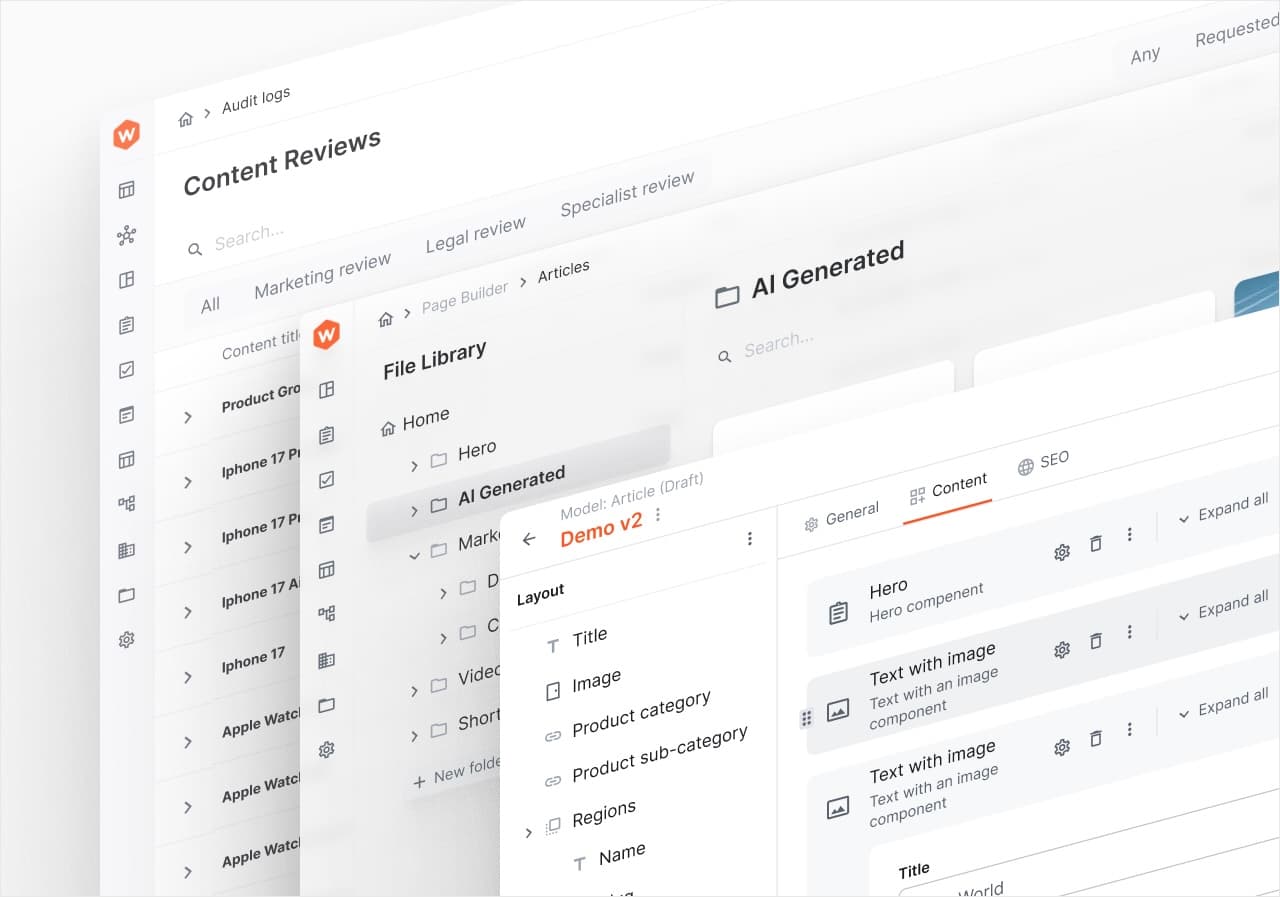
Channel breadth: Headless CMS with a GraphQL API, plus a Website Builder and File Manager on the same framework. All content is API-accessible for any consumer: web, mobile, email, syndication feeds.
Tenant isolation: Native. Multi-tenancy is a core product feature, not a plugin or workaround. A single Webiny instance manages content for an unlimited number of websites or projects with full data separation between tenants, all running from the same codebase.
Programmatic provisioning: Yes. Webiny exposes an API for tenant configuration, letting you pre-populate content and bootstrap tenants with custom templates, the exact primitive point 3 calls for.
Governance: Role-based permissions, publishing workflows, and audit logs are available in the Business and Enterprise editions. Each tenant gets its own content models, pages, assets, and settings, keeping data separate by default rather than by convention.
Economic model: Open-core. Community Edition is free (MIT-licensed). Business Edition starts at roughly $79/month. Enterprise is custom. Because Webiny is self-hosted, the marginal cost of an additional tenant is infrastructure, not a per-tenant SKU.
Deployment control: Webiny runs serverless on AWS or in your own containerized environment. On AWS it's serverless (Lambda, DynamoDB, S3, CloudFront), so there are no servers to patch and it scales with traffic. Webiny can now also be deployed in containerized environments such as Docker and Kubernetes, giving teams greater flexibility in how they run and manage their Webiny deployments.
Conclusion: Webiny is built around the tenancy criterion the other platforms treat as an edge case. If your scale is measured in brands or properties rather than pages, this is the shape you're looking for.
2. Contentful
Channel breadth: Strong. Mature GraphQL and REST APIs, wide SDK support.
Tenant isolation: Uses "spaces" as the isolation unit. Contentful caps organizations at 750 spaces, a hard ceiling worth flagging if your roadmap includes more properties than that.
Programmatic provisioning: Available via the Content Management API.
Governance: Enterprise-grade RBAC, workflows, audit logs on higher tiers.
Economic model: This is where the space model gets expensive. Third-party analyses cite per-space annual pricing in the $8,000–$75,000 range, though Contentful doesn't publish per-space costs publicly. Either way, multi-space architectures at any real scale push you into Enterprise-tier conversations quickly.
Deployment control: SaaS only. Fails criterion 6 for organizations with self-hosting requirements.
Conclusion: A strong single-tenant or small-multi-tenant choice. The 750-space cap and per-space economics make it structurally awkward for the scale this piece is about.
3. Sanity
Channel breadth: Strong. GROQ and GraphQL, structured content model, wide SDK support.
Tenant isolation: Datasets are the isolation unit. The Growth plan includes two datasets and caps at four; additional datasets are $999/month each. Beyond that, teams typically move to Enterprise or adopt a single-dataset architecture with document-level filtering, which pushes the isolation problem into application code.
Programmatic provisioning: Available via the management API.
Governance: Roles, workflows, and history on higher tiers.
Economic model: As above, the dataset-as-SKU model is the pinch point at multi-brand scale.
Deployment control: SaaS only.
Conclusion: Excellent editorial experience and content modeling. The economics of dataset isolation are the constraint for enterprise multi-tenant use.
4. Strapi
Channel breadth: REST and GraphQL APIs, open-source, Node.js-based.
Tenant isolation: None natively. Strapi's own documentation states that running one Strapi admin and backend for all websites or clients "introduces complexity and is not natively supported," and recommends separate Strapi instances, "one per project or customer," as "the simplest and most robust solution."
Programmatic provisioning: Not applicable in the native sense, because there is no native tenancy layer to provision into.
Governance: RBAC and audit logs available; scoped per-instance.
Economic model: Open-source core. Real cost at scale is operational: N tenants means N Node.js processes, N databases, N deployment pipelines to maintain.
Deployment control: Fully self-hostable.
Conclusion: A good fit for single-tenant projects or small numbers of properties. The instance-per-tenant model is a genuine operational tax at enterprise scale.
Frequently Asked Questions
Isn't multi-site the same as multi-tenant?.
No. Multi-site typically means one instance managing multiple properties from a shared content pool, with folder-level or site-level separation. Multi-tenant means logical isolation between tenants: separate content, permissions, and governance boundaries by default. Multi-site is a UX pattern; multi-tenant is an architectural guarantee. At enterprise scale, the distinction shows up the first time a regional team accidentally publishes to a sibling brand.
How many tenants before native multi-tenancy actually matters?
Roughly 20 properties is the point where the operational cost of instance-per-tenant models starts dominating engineering time. Below that, most teams can run separate instances without much pain. Above it, patching, upgrades, and observability across N instances become the primary bottleneck, and the case for a single multi-tenant platform gets hard to argue against.
Can I build multi-tenancy on top of a platform that doesn't have it natively?
Yes, but you own it. You'll be building the isolation layer, the provisioning API, the per-tenant permission enforcement, and the cross-tenant admin tooling, and maintaining all of it against every upstream release. The question isn't whether it's possible. It's whether that maintenance load is a better use of engineering time than picking a platform where it's a shipped feature.
Where does Webiny fit if I'm already committed to a SaaS CMS?
The clearest case is when you've hit a structural limit: Contentful's 750-space cap, Sanity's dataset economics, or the cost of a per-tenant SaaS SKU multiplied by your property count. Webiny's model is self-hosted and open-core, so the marginal cost of an additional tenant is infrastructure rather than a per-tenant license fee. If you don't have data residency or economic pressure pushing you off SaaS, that's a lateral move. If you do, the numbers usually work.
Multi-tenancy isn't a nice-to-have feature bolted onto an omnichannel strategy. At enterprise scale, it's the constraint that determines whether the other five criteria are even reachable. The listicles ranking on channel count and API surface aren't wrong, they're answering the question a single-brand team is asking. Evaluate against the six criteria above, and rank the platforms on how they handle the axis that actually breaks at scale.