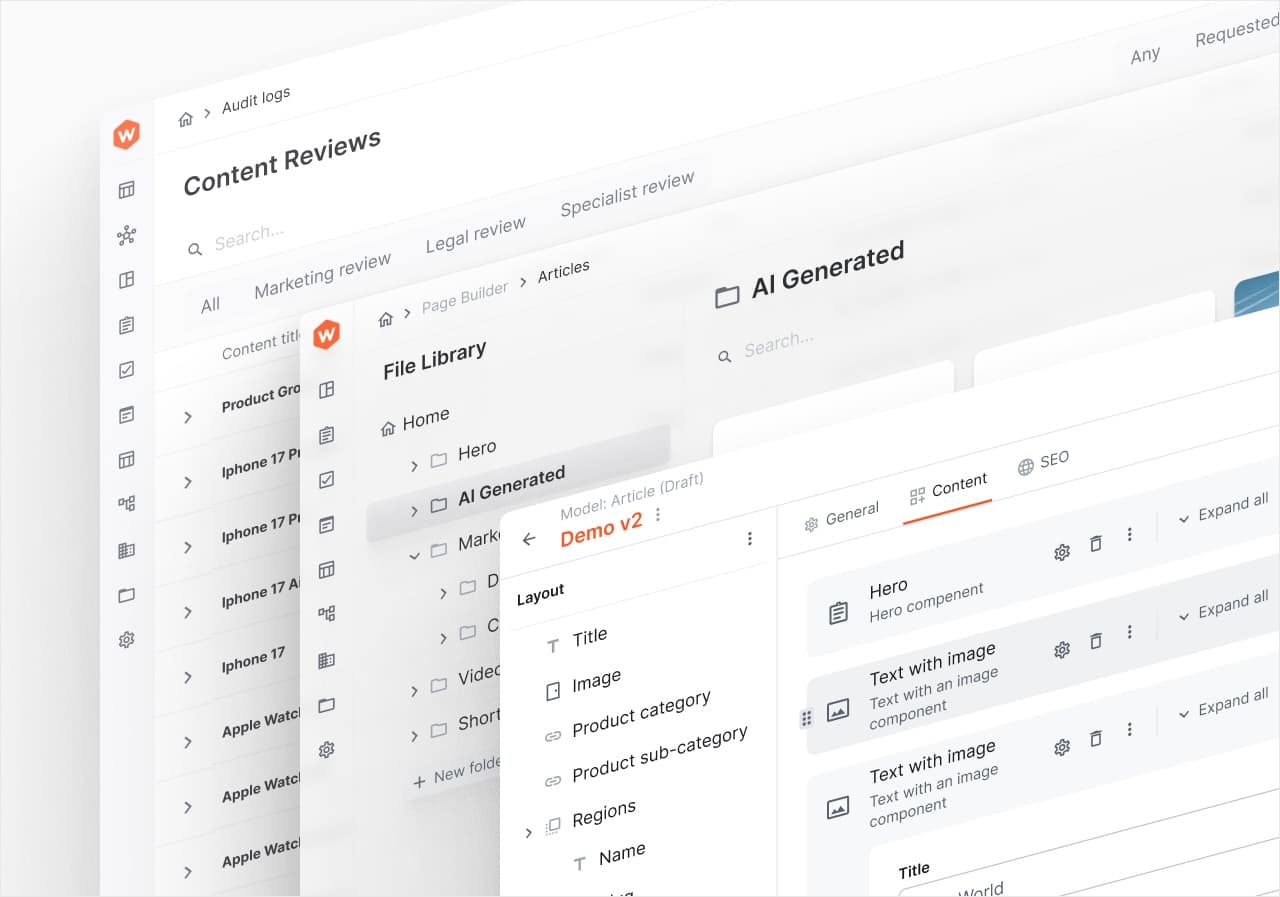
If you're searching for the best alternative to Strapi, the honest answer depends on where your project is headed. For a single site or a small content API, Strapi is hard to beatIt's fast to stand up, well documented, and has an active plugin ecosystem. But if you're a senior developer or CTO evaluating a headless CMS for multiple brands, regions, or products,something that has to scale with your organization rather than just serve a project, the strongest alternative is Webiny.
Strapi helps teams scaffold content APIs fast. Webiny is a programmable content platform built for enterprise architecture: native multi-tenancy, governance, infrastructure control, and AI that helps developers build the platform itself, not just help editors write. This comparison walks through where the two diverge, where Strapi still makes sense, and how to decide which fits your team.
Why Teams Outgrow Strapi
Strapi rarely causes problems early. The strain shows up later, when the second brand launches and compliance starts asking where the data lives, or when marketing wants to publish without filing a ticket with engineering.
The pattern is consistent. A team picks Strapi because it gets a content API running quickly. Then the requirements grow:
- A second region needs isolated content and users.
- Legal needs an audit trail and a real approval chain, not just draft-and-publish.
- The schema needs to change weekly, but every change means a redeploy.
- Infrastructure scaling becomes someone's full-time job.
Strapi wasn’t built for any of this, and that’s not a knock on the tool. It’s a content API starter. The problems above are content infrastructure problems, which is a different category of tool.
Webiny vs Strapi at a Glance
| Capability | Webiny | Strapi |
|---|---|---|
| Open-source | ✅ Yes | ✅ Yes |
| Self-hosted | ✅ Yes | ✅ Yes |
| Headless CMS | ✅ Yes | ✅ Yes |
| API | ✅ GraphQL + SDK | ✅ REST + GraphQL |
| Custom content modeling | ✅ UI / API / TypeScript | ➖ Admin UI / schema files |
| Multi-tenancy | ✅ Native isolation model | ❌ Not supported (or workarounds) |
| Visual page builder | ✅ Yes | ❌ No |
| Publishing workflows | ✅ Business & Enterprise | ➖ Enterprise-only |
| AI | ✅ Architectural agent context | ➖ Editor-focused AI features |
| MCP server | ✅ Advanced | ➖ Basic features only |
The rest of this post unpacks the rows that matter most for senior teams.
Multi-Tenancy: \ How multi-tenancy actually works
This is the cleanest dividing line between the two platforms, and the easiest to quantify.
Webiny hosts isolated tenants from a single deployment,each with separate data, users, assets, and permissions. Global content can be defined once and inherited or overridden locally, so a multi-brand or multi-region organization runs on one platform with shared governance.
Strapi has no concept of multi-tenancy. Supporting multiple brands or regions means running separate instances, each with its own database and deployment. That adds up fast: ten tenants can mean roughly ten deployments to run and patch, and the count climbs from there. Webiny hosts many isolated tenants from a single deployment.
For a single-brand project, this never comes up. For an agency running client sites, a SaaS embedding a CMS per customer, or a global company with regional teams, it's the whole ballgame.
Extensibility and AI: What you can build on each platform
Both platforms ship AI features, and both help editors. Webiny goes a step further: it extends the same AI to the developers building the platform itself.
Editor AI: covered by both
Strapi AI generates schemas from prompts, auto-tags media, and translates content, speeding up the people working inside the admin panel.
Webiny matches this and goes further on the editorial side: version-difference summaries, automatic SEO suggestions, image tagging, and persona-based content generation — all inside the editorial flow, all model-agnostic, and all running inside your own cloud rather than a third-party service. So if editor-facing AI is the deciding factor, both platforms meet it.
Developer AI: where Webiny is alone
The gap opens on the developer side. Webiny ships an MCP server that gives coding agents, such as Claude Code, Cursor, Windsurf, architectural context for the platform. Instead of managing content, those agents build features, extensions, and integrations against a strongly typed framework. Because the framework is typed and the extension layer is formal, AI-generated code fits the existing patterns and stays maintainable across upgrades, rather than producing one-off scripts that rot.
Strapi's AI stops at the admin panel. Webiny's reaches into the codebase, which is what matters most to the senior developers who own it.
The extensibility models differ accordingly. Webiny provides lifecycle hooks, background jobs, CI/CD integration, and a formal extension layer. Strapi uses a plugin architecture that's flexible for standard cases, but enterprise patterns, like background processing, tenant-aware logic, cross-project orchestration, tend to require custom engineering outside the platform.
Editorial Experience: Running content operations at scale
Strapi's admin panel is genuinely good: intuitive, approachable, and well-suited to smaller teams. At scale the gap isn’t UI polish. Webiny ships full applications alongside the headless CMS: a Website Builder, a Publishing Workflows engine, a File Manager DAM, and a Tenant Manager, each one programmable, governed, and running inside your own cloud. In Strapi these are gaps the team fills with frontend work, plugins, or external tools.
Visual Website Builder
Webiny's Website Builder is a drag-and-drop visual builder that uses your actual React/Next.js components — developers define the approved components, props, validation, and theme, and editors compose on-brand pages without code, with live responsive preview. It scales to 100,000+ static and dynamic pages, and pages can be generated programmatically via API — useful for seeding new tenants.
Strapi has no page builder. Layout and composition stay with the frontend team: manageable on a small team, a bottleneck when marketing needs to move independently.
Approval workflows
Webiny's Publishing Workflows let teams model multi-step approval chains, Marketing to Legal to Localization, each step with its own reviewers, required comments, and notification rules. Rejected content returns to draft automatically with notes, reviewers get personalized dashboards of what's awaiting action, and updates push to Slack, Teams, or email. Every step is logged, versioned, and recoverable, and the whole process is defined as code.
Strapi provides draft and published states. Structured sign-off chains with multiple reviewers have to be built outside the CMS.
Asset management
Webiny's File Manager is a self-hosted Digital Asset Manager, not just a media library: folders and sub-folders, custom metadata schemas defined as code, powerful search across tags and metadata, folder-level access control, bulk actions, AI tagging and alt text, and global CDN delivery — architected on serverless to handle very large asset libraries. Assets are governed as part of the system, with lifecycle hooks to automate transformations, thumbnails, and webhooks.
Strapi's media library handles standard cases well, including AI-generated alt text. But structured folder hierarchies, custom metadata, and asset governance require additional tooling.
Multi-brand governance
This is where the applications compound. As covered above, Webiny's Tenant Manager gives each brand, region, or market an isolated tenant — but from the editor's seat, the win is shared governance: global content defined once and propagated or overridden locally, tenants grouped in folders, and each tenant keeping its own versioning, audit logs, and workflows. Strapi has no equivalent, so cross-brand editorial governance lives in separate instances with no shared layer.
Architecture: Serverless IaC vs Managed Node
This is the difference that compounds over time, and it's where CTOs should focus first.
Infrastructure and scaling
Webiny deploys into your own AWS account as serverless infrastructure-as-code. Scaling, fault tolerance, and capacity are handled by the platform's architecture rather than by your team. There are no servers to size and no idle capacity to pay for between traffic spikes.
Strapi runs as a Node.js application. You bring the database, configure the hosting, and own the scaling strategy. For a small project that's a reasonable amount of work. At enterprise scale, with high traffic, multiple environments, availability targets, managing that stack becomes a dedicated responsibility rather than a setup step.
Where Strapi Still Wins
A fair comparison has to name the cases where Strapi is the better pick — and there are several.
- Single projects and smaller teams. If you need a content API for one site or app, Strapi gets you there faster with less conceptual overhead.
- REST-first stacks. Strapi offers REST and GraphQL out of the box. Webiny is GraphQL-first, so REST-centric teams may prefer Strapi's defaults.
- Plugin ecosystem. Strapi has a large, active marketplace of community plugins for common needs.
If your roadmap genuinely ends at "one well-built content API," Strapi is a sensible, popular, defensible choice. The question is whether that's where your roadmap actually ends.
Which One Fits Your Team
A simple way to decide:
Choose Strapi if you're building a content API for a single project, your team is small, you're REST-first, and you don't anticipate multi-brand, multi-region, or strict governance requirements.
Choose Webiny if you're building content infrastructure that has to scale across brands, regions, or products; you need native multi-tenancy and real approval workflows; you want serverless infrastructure in your own cloud; and you want AI that extends the platform, not just the content inside it.
Talk It Through With an Engineer
If you're weighing this decision for a real architecture, with multiple tenants, governance requirements, infrastructure you need to own, the fastest way to pressure-test it is a conversation, not a feature checklist. You can talk to the Webiny team about your specific setup and where the trade-offs land for you. No pitch required. Bring your hardest requirement and see how it holds up.
Frequently Asked Questions
What’s the difference between Strapi and Webiny?
Strapi is a headless CMS built to scaffold content APIs quickly. Webiny is a programmable content platform built for enterprise architecture, with native multi-tenancy, governance, infrastructure control, and developer-facing AI. For a single site or content API, Strapi gets you running faster. For multiple brands, regions, or products that need to scale on shared infrastructure, Webiny is built for that pattern.
Does Strapi support multi-tenancy?
Not natively. Supporting multiple brands or regions in Strapi means running separate instances, each with its own database and deployment. Webiny hosts isolated tenants from a single deployment, each with its own data, users, assets, and permissions, with global content defined once and overridden locally.
What’s the best CMS for managing multiple brands or client sites?
Look for native multi-tenancy, shared governance across tenants, and per-tenant versioning and audit logs. Platforms built around separate instances per brand work at a small scale but get harder to patch and govern as the count grows. Webiny is designed for this case specifically: agencies, multi-region companies, and SaaS products embedding a CMS per customer. If you only manage one brand, this won’t be a deciding factor.