Heads up! This article was written before Webiny 6.0 was released and may contain outdated information.

Mislav Streicher
Heads up! This article was written before Webiny 6.0 was released and may contain outdated information.
Webiny is the AI-programmable CMS that gives enterprises full control. Build, extend and automate your content operations with a platform designed to be shaped by both developers and AI agents.
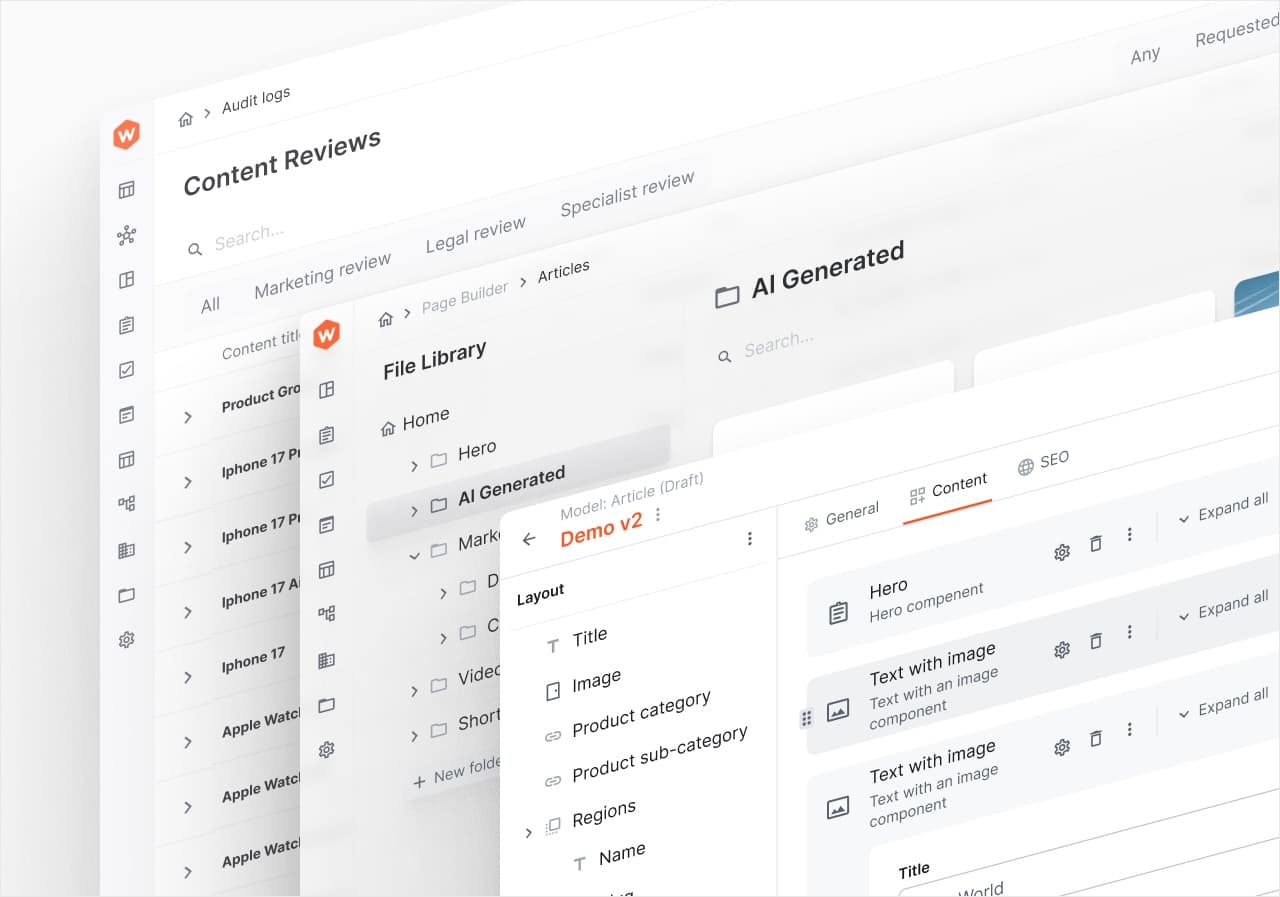
Contentful is a cloud-based, fully-managed, headless content management solution (CMS) that fast-tracks the process of building multi-brand, omnichannel content experiences.
Using the Contentful platform, you can create a unified content repository and use it to deliver content across all customer touchpoints. The Contentful Studio is a visual experience builder that simplifies collaboration between different members of a digital team.
Here are some additional Contentful features:
Contentful is undoubtedly a reliable headless CMS, but it does have certain limitations. Let’s discuss some of its constraints that prompt users to explore alternatives:
Contentful’s licensing costs can be prohibitive for certain businesses. The Basic package costs $300/month and only includes 20 users, 1 space license, 4 roles, and 4 locales. It also enforces a 1000 MB limit on asset uploads.
The Enterprise package allows you to customize the number of users, spaces, roles, and more, but its cost often exceeds the budget of smaller or medium-sized companies.
Both the Contentful Studio and platform can pose a learning curve for users without prior experience with headless CMS platforms. After you sign up, the welcome dashboard and the Content and Media sections don’t do a good job of providing clear guidance on getting started or navigating the platform’s features, especially if you choose not to start with a template.
Given Contentful's proprietary nature, some businesses face challenges with its adaptability and scalability. For example, as a cloud-based service, Contentful does not offer the option for self-hosting, let alone an architecture that automatically scales to accommodate fluctuating workflows.
There’s no way to customize the Contentful platform to align with your unique business needs. For example, you can’t optimize the data storage layer, extend the API, or tweak the UI. In contrast, open-source headless CMSs, like Webiny, inherently offer these capabilities.
While searching for flexible alternatives to Contentful, use the following factors to make an informed choice for your organization.
Look beyond the initial licensing or subscription fees to consider costs related to deployment, implementation, customization, integrations, support plans, and ongoing maintenance. This will help you make a financially prudent call. Also, assess the potential ROI of incorporating the Contentful alternative into your workflows if possible.
The platform should offer a user-friendly experience that doesn't require extensive technical expertise from any team member. Marketers, for example, should have a sleek and intuitive interface for defining reusable components. Developers should find it easy to integrate with the platform using their preferred frontend framework or programming language.
Go for a Contentful alternative that marries ease of use with boundless customizability. Ideally, you should be searching for a battle-tested open-source CMS, like Webiny, which enables you to customize any aspect of the platform through its accessible source code.
Evaluate the interoperability of the Contentful alternatives you are considering. Do they have plugins and integrations available on their marketplace? Will they seamlessly integrate with other tools and services in your ecosystem? Do they have a plugin- or module-based architecture that enables seamless extensibility?
It’s important to prioritize API-first platforms, which are interoperable by design.
Lastly, consider the availability and responsiveness of the customer support offered by the Contentful alternative. Search for vendors that have live chat, email, phone, and ticket-based support options, extensive documentation, active forums, help center resources, and (if applicable) dedicated account management with SLA tracking.
Before we share our top 5 Contentful alternatives, let’s quickly go through the categories of alternatives available in the market today.
Open-source CMSs, like Webiny and Strapi, provide endless customization capabilities and ongoing support from active communities.
Cloud-based CMS platforms, like Sanity and Storyblok, offer the scalability of the cloud but can sometimes limit customizability.
Enterprise-grade solutions, like Webiny and Contentstack, are purpose-built to meet the complex needs of large organizations that deal with high volumes of data.
Specialized content management systems, like Shopify for e-commerce and Document360 for documentation, focus on addressing the specific needs of particular industries or use cases.
Digital experience platforms, like the Adobe Experience Manager and Liferay DXP, unify content management, marketing automation, digital asset management, and other similar functionalities.
Now, let’s turn our attention to the 5 most viable Contentful alternatives that you should consider for your business:
Webiny is an enterprise-grade, cloud-based, and open-source headless CMS that you can deploy on your own terms inside your own AWS account. It includes all the features that are present in Contentful, such as visual experience building, built-in localization, version control, role-based access control, publishing workflows, and more.
However, Webiny goes beyond simple parity by offering these standout functionalities:
Webiny caters to businesses across various scales. Individual users and small businesses can benefit from a free starting point, while larger enterprises can go with the Enterprise package, featuring SLA support and advanced compliance features. Moreover, there’s also a mid-tier plan (known as Business) priced at $9/user/month that’s geared toward growing businesses.
Webiny doesn’t offer deployment support to customers in its free or mid-tier plans.
Sanity is a composable content cloud platform that has three main components: content lake, a fully-managed document store; APIs for integrations; and Sanity Studio, an independently deployable application for marketers and content creators.
Here are some useful Sanity features:
Individuals and freelancers can get started for free with Sanity, while small-to-medium businesses have the option to select the mid-tier plan (known as Growth) priced at $15 per user per month. The Enterprise package is a good fit for large organizations that need uptime SLA with dedicated support and feature customization.
Strapi is an open-source Node.js-based CMS that can be deployed in your own environment, as well as the fully managed Strapi Cloud. Like Contentful, Strapi comes with both RESTful and GraphQL API support, a visual content type builder, e-commerce and omnichannel support, and multi-framework support.
Here are some key Strapi features:
For people looking to self-host, Strapi offers two plans: a Free plan that caters to individuals and startups and an Enterprise plan with custom pricing for large organizations. For cloud-preferring customers, Strapi provides a Pro plan priced at $99/month and a Team plan that costs $499/month.
Storyblok is a fully managed, cloud-native headless CMS that is powering businesses across different industries, including e-commerce, transportation, finance, and software. Like Contentful, and unlike Webiny and Strapi, Storyblok can’t be self-hosted.
Here are some highlights of the Storyblok platform that you should know:
Storyblok has a flexible pricing model with five plans:
Contentstack emerges as one of a few leading headless CMSs, compatible with major cloud environments like Microsoft Azure and AWS. As a cloud-native SaaS platform, it leverages a microservices architecture, efficient load balancing, and a global CDN to deliver strong performance and scalability.
Here are some highlights of the Contentstack platform that you should be aware of:
Contentstack's pricing model includes three paid packages and a free trial, addressing the needs of businesses of all sizes. It is important to note that all packages come with bandwidth limitations, and unrestricted API calls and storage are exclusive to the highest-tier package. You'll need to contact their sales team to find out more as they don't advertise package costs on their website.
While Contentstack offers robust features and flexibility, potential users should consider the bandwidth limitations and API call restrictions in lower-tier packages. These factors could influence scalability and operational capacity for growing businesses.
To find out more about Contentstack, take a look at the following guides:
To ensure you make the best choice for your organization from the top Contentful alternatives listed above, follow this checklist:
Start by clearly defining your goals and aspirations. Next, assess how well each platform aligns with these objectives. For example, if you want automatic, limitless scalability for your content infrastructure, then Webiny would be a compelling choice.
As mentioned earlier, remember to consider the total cost of ownership while choosing a Contentful alternative. This will include costs related to deployment, setup, training, security, and maintenance.
If you are looking for enterprise-grade performance with the least TCO, then Webiny could be a great fit. Its serverless architecture is very cost-effective compared to traditional VM-based deployments.
Take into account the preferences and skill sets of the people who will be using the CMS. Go for a product that streamlines the process of omnichannel experience design for both technical and non-technical personnel.
For example, if your team is already familiar with the HubSpot ecosystem, then the HubSpot CMS can work well for you. However, bear in mind that HubSpot CMS doesn’t offer robust headless capabilities.
Contentful is a highly scalable platform, so when looking for an alternative, prioritize scalability that matches or surpasses Contentful’s capabilities. For example, Webiny goes beyond basic scalability by offering on-demand scalability through its serverless infrastructure.
Contentful is a popular headless CMS that offers several features to streamline content management. However, its steep pricing, limited customizability, and lack of self-hosting options prompt users to seek alternatives. If you find yourself in the same situation, we hope this guide has been beneficial.
Remember, to choose the best Contentful alternative for your organization, you must consider the checklist and factors discussed above. Go beyond feature lists and price tags to assess security, flexibility, interoperability, ease of use, level of support, and other important aspects.
For more in-depth Contentful comparisons, check out the articles below: