Webiny vs Directus
Directus focuses on managing SQL data through a clean UI.
Webiny is built for teams designing scalable, multi-tenant, extensible content architectures — with infrastructure, workflows, and governance included.
Webiny in 90 Seconds
Database admin vs a programmable content platform
Webiny vs Directus Comparison
Discover the similarities and differences between the two platforms.
Webiny
Directus
Open-source
Self-hosted
GraphQL API
Custom backend logic
Built-in publishing workflows
Tenant isolation (data, users, assets, permissions)
Visual page builder
Webiny vs Directus: Cost comparison
Estimate the cost of Webiny's license and hosting, and compare it to Directus's pricing for different project sizes.
For a more detailed comparison including other competitors, check out the full cost calculator.
Webiny vs Directus
Webiny cost = Business license + estimated AWS hosting. Directus uses published SaaS pricing.
Pricing sourceLast verified: 2026-03-06. Compared against Directus Cloud (Enterprise tier). Directus is also available as a self-hosted open-source project.
Built for engineers designing systems — not just managing tables.
A programmable foundation with tenancy, workflows, and infrastructure already solved.
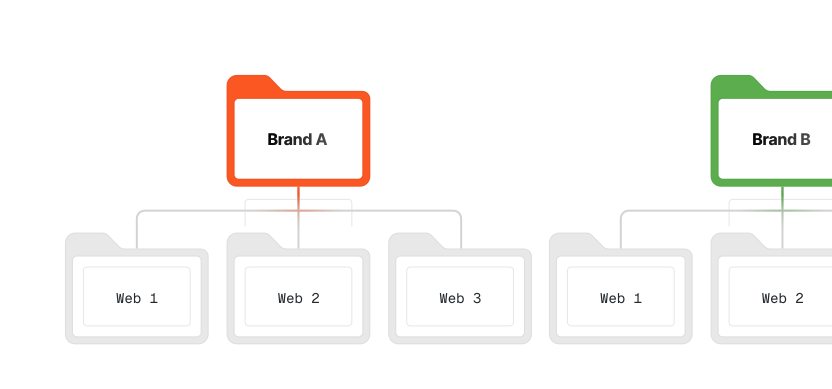
Multi-tenancy without architectural hacks
In Directus, multi-project setups typically mean separate instances or careful database modeling.
In Webiny, multi-tenancy is native. One deployment can host thousands of isolated tenants — with separated data, users, permissions, and assets — all managed programmatically.
Infrastructure that’s part of the product
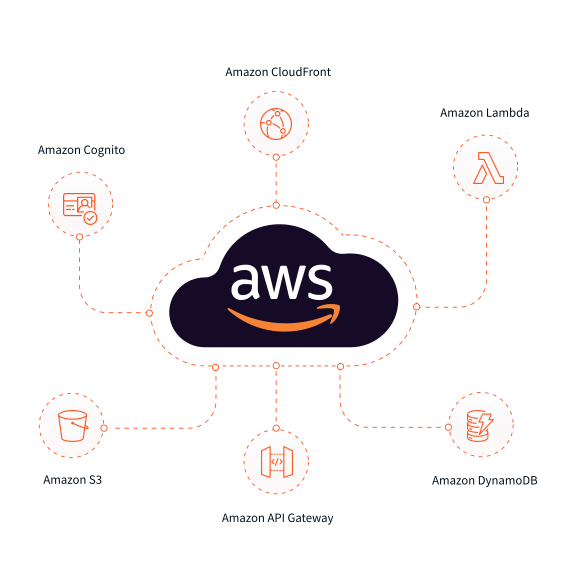
With Directus, you design and maintain your own scaling strategy.
With Webiny, serverless infrastructure on AWS is part of the foundation. Deployment is automated, scaling is handled by cloud primitives, and DevOps overhead stays minimal even at enterprise scale.
Lifecycle-driven architecture
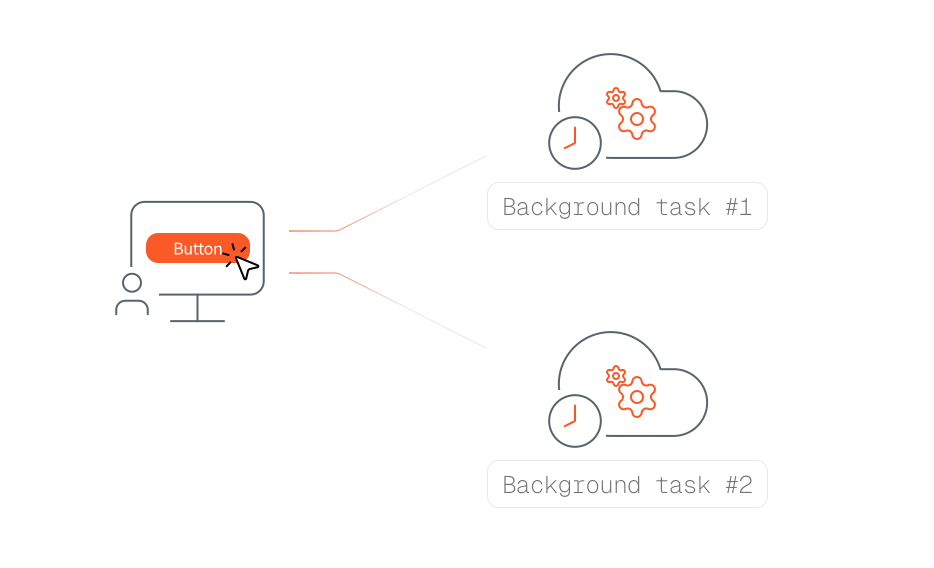
Directus provides hooks around data operations.
Webiny provides lifecycle events across content, assets, tenants, and workflows — tightly integrated with background jobs, queues, and CI/CD pipelines. It’s not just reacting to data changes. It’s orchestrating systems.
A content platform — not just a database UI
Directus shines as a database-first admin interface.
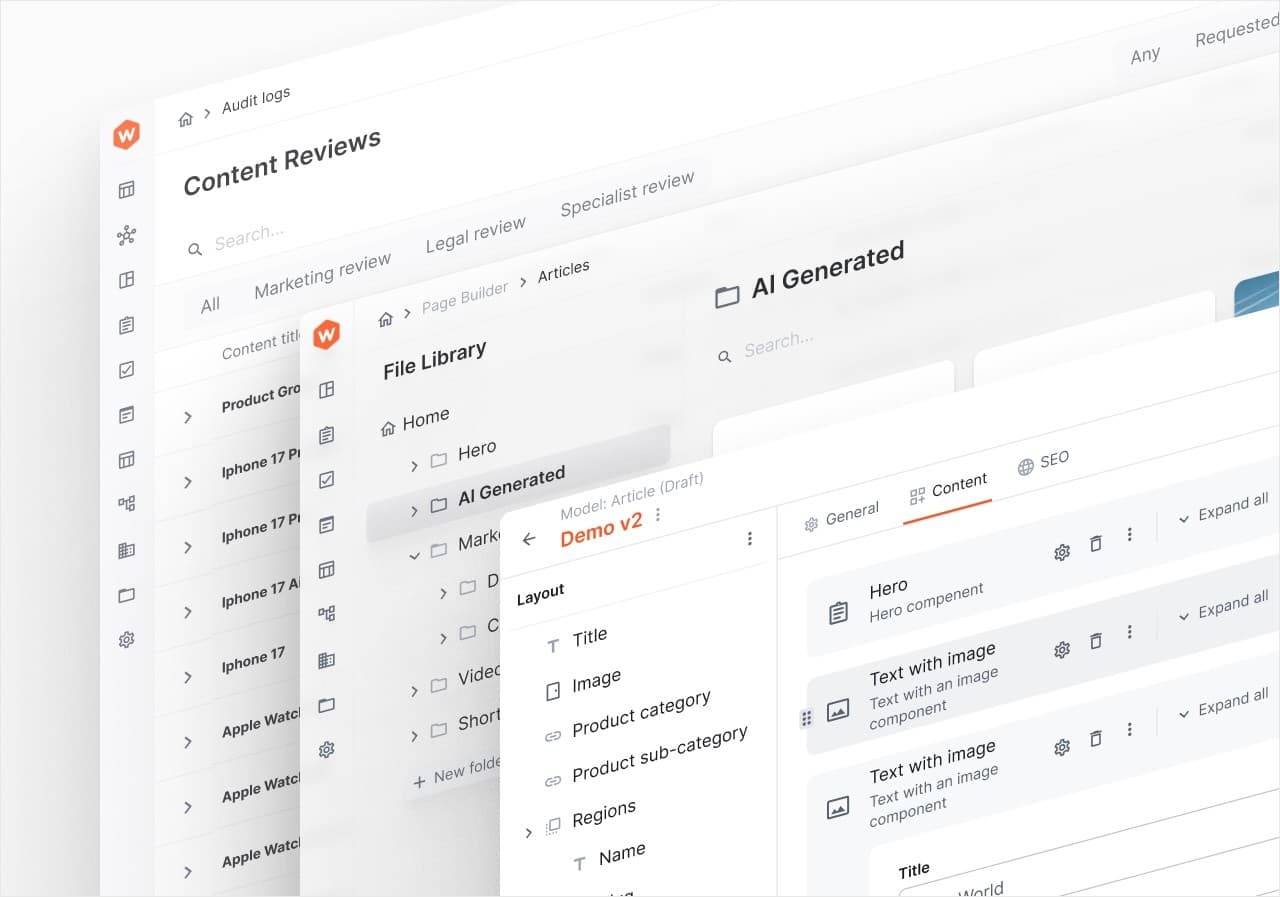
Webiny combines Headless CMS, DAM, publishing workflows, and optional visual page builder into one programmable system. You’re not stitching tools together — you’re extending a cohesive platform.
No lock-in at every layer
Both are open-source.
But Webiny goes further by giving you full source, infrastructure templates, CLI tooling, and extension scaffolding designed for long-term ownership. If your team builds custom logic, you own it end-to-end — code, cloud, and data.
Programmable CMS
Define content models, APIs, workflows, and behavior in code — so your CMS evolves like real software, not a locked product you work around.
Learn moreLifecycle Events & Automation
React to every content change with code — trigger automations, enforce business rules, and connect Webiny to your systems in real time.
Learn moreEmbedded & White-Label CMS
Embed Webiny directly into your application and fully white-label the experience — so your users manage content inside your product, not in a separate CMS.
Learn moreBuilt for teams that publish at scale — not just manage entries.
Structured workflows, asset governance, and multi-brand control — inside one unified platform.
Structured publishing, not just permissions
Directus focuses on roles and data permissions.
Webiny includes structured publishing workflows with draft states, approvals, scheduled releases, and audit logs built into the experience. Editors see exactly what’s in review and what’s going live.

One place for content and assets
With Directus, asset management is functional but secondary.
Webiny includes a full Digital Asset Manager with folders, tagging, search, and CDN-backed delivery — integrated directly into content workflows. Upload once. Reuse everywhere.

Built for multi-brand and global teams
In Directus, multi-brand setups require careful modeling and permission structuring.
In Webiny, each brand, region, or client can live in its own isolated tenant — with dedicated users, content, and workflows — while still sharing infrastructure.

Visual page creation when needed
Directus is purely API and data driven.
Webiny can optionally provide a visual drag-and-drop Website Builder on top of your components — fully integrated with your content models and APIs. Marketing teams get autonomy. Developers keep control.
.png%3Foriginal&w=3840&q=75)
Versioning & Rollback
Every change is tracked, every version is preserved, and rolling back is instant — so teams can move fast without risking what’s live.
Learn moreData Ownership & Governance
Webiny runs entirely in your cloud — so your content, assets, and metadata never leave your control, are never reused, and are never trained on by third parties.
Learn moreContent Inheritance & Propagation
Define global content once, propagate it safely across tenants, and give local teams the freedom to extend or override — all controlled through code and rules you own.
Learn moreAI that supports, not complicates
Webiny includes AI-powered features like version difference summaries, automatic SEO suggestions, image tagging, and persona-based content generation — directly inside the editorial flow.
Learn moreA Data Admin vs A Content Platform
Directus is built to expose and manage database content.
Webiny is built to power composable content platforms — with multi-tenancy, governance, workflows, and infrastructure designed in from day one.
If you need a clean SQL admin, Directus is a solid choice.
If you’re designing the backbone of a SaaS product or enterprise ecosystem, Webiny aligns with the architecture you’re building.