Webiny vs Adobe Experience Manager (AEM)
Webiny gives you full control, open architecture, and serverless scalability inside your own cloud — without the complexity, heavyweight infrastructure, and vendor lock-in traditionally associated with AEM.
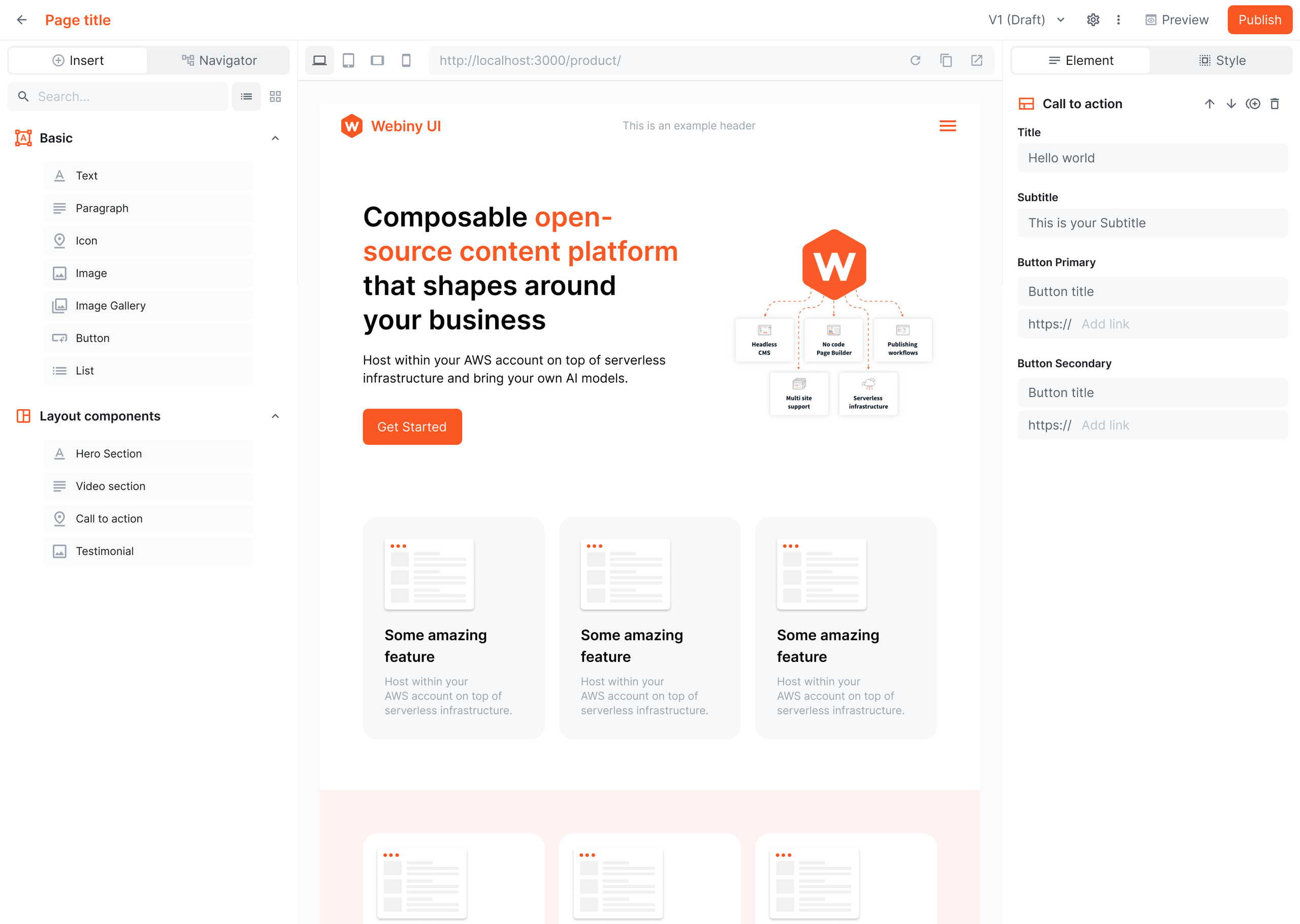
Webiny in 90 Seconds
Modern composable content platform vs legacy enterprise DXP
Webiny vs Adobe Experience Manager
Keep it focused on things enterprises care about:
Webiny
AEM
Headless CMS capabilities
Visual page editing
Role-based access control
True multi-tenancy in one instance
Extensibility via code
Serverless architecture
Infrastructure control
Open-source core
Technology stack
Scaling costs
Webiny vs AEM: Cost comparison
Estimate the cost of Webiny's license and hosting, and compare it to AEM's pricing for different project sizes.
For a more detailed comparison including other competitors, check out the full cost calculator.
Webiny vs AEM
Webiny cost = Business license + estimated AWS hosting. AEM uses estimated SaaS pricing.
Pricing sourceLast verified: 2026-03-06. AEM does not publish public pricing. These figures are industry estimates based on analyst reports and partner quotes.
Built for modern engineering teams
Open. Serverless. Extensible by design.
Open architecture, no black box
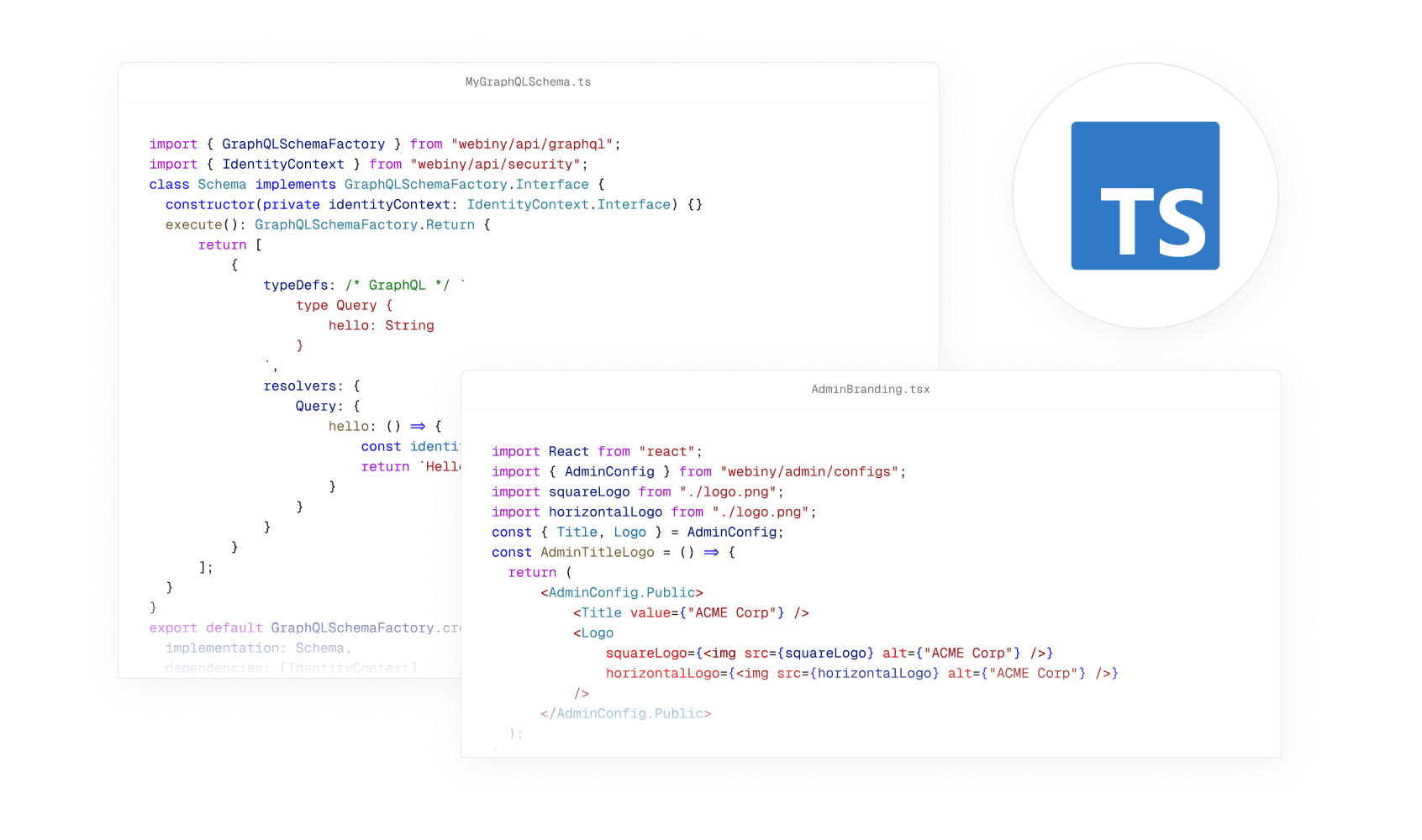
Webiny is open-source and built around TypeScript and GraphQL. You extend APIs, hook into lifecycle events, and version everything through CI/CD — just like the rest of your stack.
With AEM, deeper customization typically means working within a Java-based ecosystem that can add architectural and upgrade complexity.
Composable and frontend-agnostic
Webiny works with any frontend and any hosting strategy. It integrates cleanly into modern, composable architectures without forcing ecosystem dependency.
AEM fits best within the broader Adobe stack. Webiny fits wherever your architecture already lives.
.svg)
True multi-tenancy
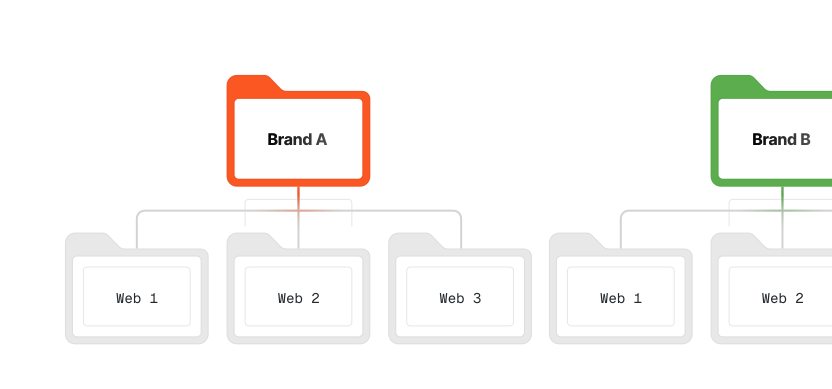
Webiny was designed for multi-tenant setups. Isolated data, users, and assets live within one deployment, and tenants can be provisioned and automated programmatically.
In AEM, similar setups are possible — but often require significant architectural effort.
Serverless by default
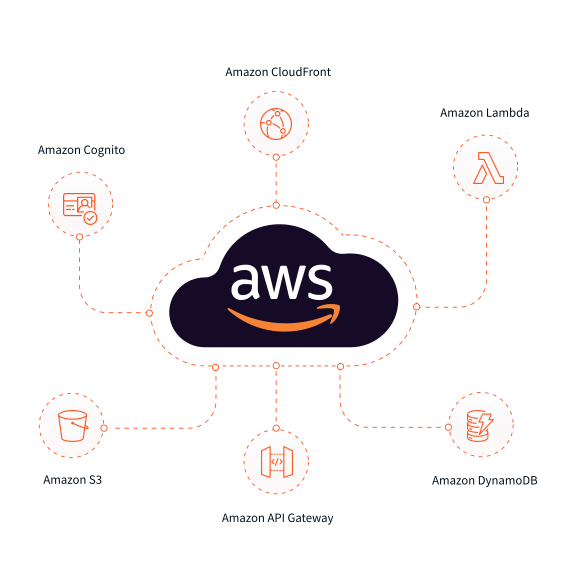
Webiny runs fully serverless inside your AWS account. Scaling, resilience, and availability are handled by managed cloud services — not custom infrastructure work.
AEM environments are traditionally heavier and more operationally demanding. Webiny keeps DevOps overhead minimal from day one.
No lock-in, predictable evolution
Webiny runs inside your own AWS account and is open-source, so you fully control your data, infrastructure, and extensions. Your team decides how the platform evolves — not a vendor roadmap.
With AEM, long-term flexibility is naturally tied to Adobe’s ecosystem, licensing model, and release cycles.
Modern developer experience
Webiny is built around TypeScript, GraphQL, and CI/CD workflows, so extending it feels like working on the rest of your product — versioned, testable, and predictable.
AEM development typically requires deeper knowledge of its Java-based architecture, which can increase complexity and reliance on specialized expertise.

Programmable CMS
Define content models, APIs, workflows, and behavior in code — so your CMS evolves like real software, not a locked product you work around.
Learn moreLifecycle Events & Automation
React to every content change with code — trigger automations, enforce business rules, and connect Webiny to your systems in real time.
Learn moreEmbedded & White-Label CMS
Embed Webiny directly into your application and fully white-label the experience — so your users manage content inside your product, not in a separate CMS.
Learn moreEnterprise-grade editing — without the overhead
Powerful where it matters. Simple where it should be.
Both Webiny and Adobe Experience Manager are built for enterprise teams. The difference is how much complexity editors have to navigate to get their work done.
Visual editing with guardrails
Webiny allows editors to build pages visually using developer-approved components, ensuring brand consistency by design. Live preview is immediate and predictable.
AEM also supports visual editing, but component governance and template complexity can make changes more dependent on developer involvement.
.png%3Foriginal&w=3840&q=75)
Built-in governance
Workflows, versioning, audit logs, scheduled publishing, and rollback capabilities are included out of the box. Editors can move fast while staying compliant and traceable.
In AEM environments, governance is strong, but often spans multiple modules and configurations that can feel more operationally heavy.
.png%3Foriginal&w=3840&q=75)
Clean, focused editorial experience
Webiny provides a modern, intuitive UI built around real content workflows. Editors see exactly what they need — no overloaded dashboards or layered configuration screens.
AEM is powerful, but its breadth often translates into heavier interfaces that can require more onboarding and training.

Faster content operations
Bulk actions, folder organization, localization support, and a built-in trash bin make day-to-day content management efficient and safe. Editors can confidently experiment without fear of irreversible mistakes.
AEM offers similar capabilities, but workflows and content structures can become complex in large enterprise setups.

Versioning & Rollback
Every change is tracked, every version is preserved, and rolling back is instant — so teams can move fast without risking what’s live.
Learn moreData Ownership & Governance
Webiny runs entirely in your cloud — so your content, assets, and metadata never leave your control, are never reused, and are never trained on by third parties.
Learn moreContent Inheritance & Propagation
Define global content once, propagate it safely across tenants, and give local teams the freedom to extend or override — all controlled through code and rules you own.
Learn moreAI that supports, not complicates
Webiny includes AI-powered features like version difference summaries, automatic SEO suggestions, image tagging, and persona-based content generation — directly inside the editorial flow. AEM integrates AI through Adobe Sensei, but advanced capabilities often tie into broader Adobe products and ecosystem tooling.
Learn moreA modern alternative to heavyweight DXPs
Webiny is built for a different generation of architecture: cloud-native, composable, multi-tenant, and fully under your control. It gives enterprises governance, scale, and extensibility — without the operational drag.
If you want a fully managed Adobe-centered ecosystem, AEM may be the right fit.
If you want ownership, architectural flexibility, and predictable evolution inside your own cloud, Webiny becomes the more strategic foundation.