Heads up! This article was written before Webiny 6.0 was released and may contain outdated information.

Sven Al Hamad
Heads up! This article was written before Webiny 6.0 was released and may contain outdated information.
Webiny is the AI-programmable CMS that gives enterprises full control. Build, extend and automate your content operations with a platform designed to be shaped by both developers and AI agents.
Serverless computing allows developers to build and run applications without managing the underlying servers. Unlike traditional cloud setups using VMs or containers, serverless abstracts infrastructure management entirely—scaling automatically and charging only for actual usage, not uptime.
Serverless can significantly reduce operational costs, speed up product development, and allow for rapid scaling. These advantages free up resources for innovation and faster go-to-market strategies, helping businesses outpace slower-moving competitors.
In theory, yes—thanks to consumption-based pricing and no idle resource costs. However, the real-world savings depend on workload patterns and the complexity of implementation. For greenfield projects, cost benefits are more achievable than for complex migrations.
Major challenges include a lack of internal serverless expertise, unfamiliar security models, the need for custom tooling, and the inability to reuse legacy systems. These hurdles often delay or prevent adoption altogether without the right tools or strategy.
Not typically. Serverless requires applications to be architected specifically for event-driven, stateless execution. Migrating legacy systems can be complex and costly, often requiring significant re-engineering.
Webiny provides a complete serverless application framework and CMS tailored for AWS. It includes all the tooling, libraries, and infrastructure abstraction needed to build scalable applications quickly—removing the typical pain points of serverless adoption.
Yes, with the right tools like Webiny. It offers documentation, standardized practices, and built-in features that allow teams to focus on business logic rather than low-level infrastructure or tooling concerns.
Currently, Webiny supports AWS. Support for additional cloud providers is planned for future releases.
Yes, Webiny has a free community open source version. You can use, modify, and deploy it freely under its license. This allows businesses to explore and adopt serverless without high upfront costs.
Ever wondered what it might mean for your business or organization to adopt serverless? Not so much from the technical perspective, but more from a business perspective. How could serverless help move your business faster and outpace competitors?
In this article, I'll go through several of those reasons, the theory behind them, how the theory might not work in practice, and what it takes to actually takes to extract the full benefits from serverless infrastructure.
There are more or less 4 basic premisses to serverless offerings:
These 4 benefits when combined can make a big difference to your business. Let's look at how that might work.
Starting with the obvious one. Because of the consumption-based pricing, you essentially stop paying for things like server idle time or any resources you have that you are not utilizing 100%.
Deloitte made a research article comparing the cost of an identical application running on VMs (EC2) and on serverless. It showed that in "practice" you can save anywhere between 60% and 80% on cloud infrastructure costs.
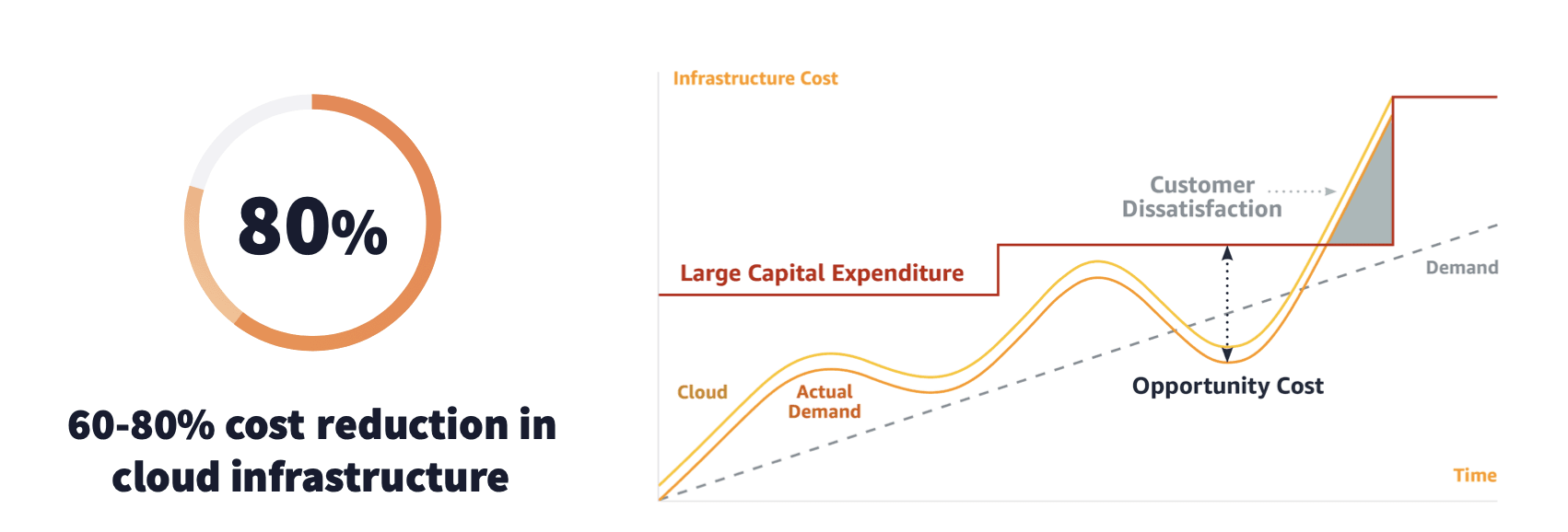
Source: Deloitte Consulting - Determining the Total Cost of Ownership of Serverless Technologies when compared to Traditional Cloud
So the theory is that if you combine the 80% of savings in the cloud infrastructure cost and the 60% of savings in terms of the maintenance cost, you will have a significant part of the budget that can now be reinvested. If you decided to reinvest this budget into hiring more engineers, you will be able to develop your products much faster. This will bring many of your innovations to the market sooner, which will drive the adoption of your product. Essentially, you now have the potential to move faster than your competitors due to serverless.
Now, let's look at the practical side.
If we look at this graph (and there are many similar ones across the internet) it shows the evolution of infrastructure. Over the years, the complexity of running your applications has been gradually reducing. And now with serverless, you finally don't need to worry about anything except your own application code.
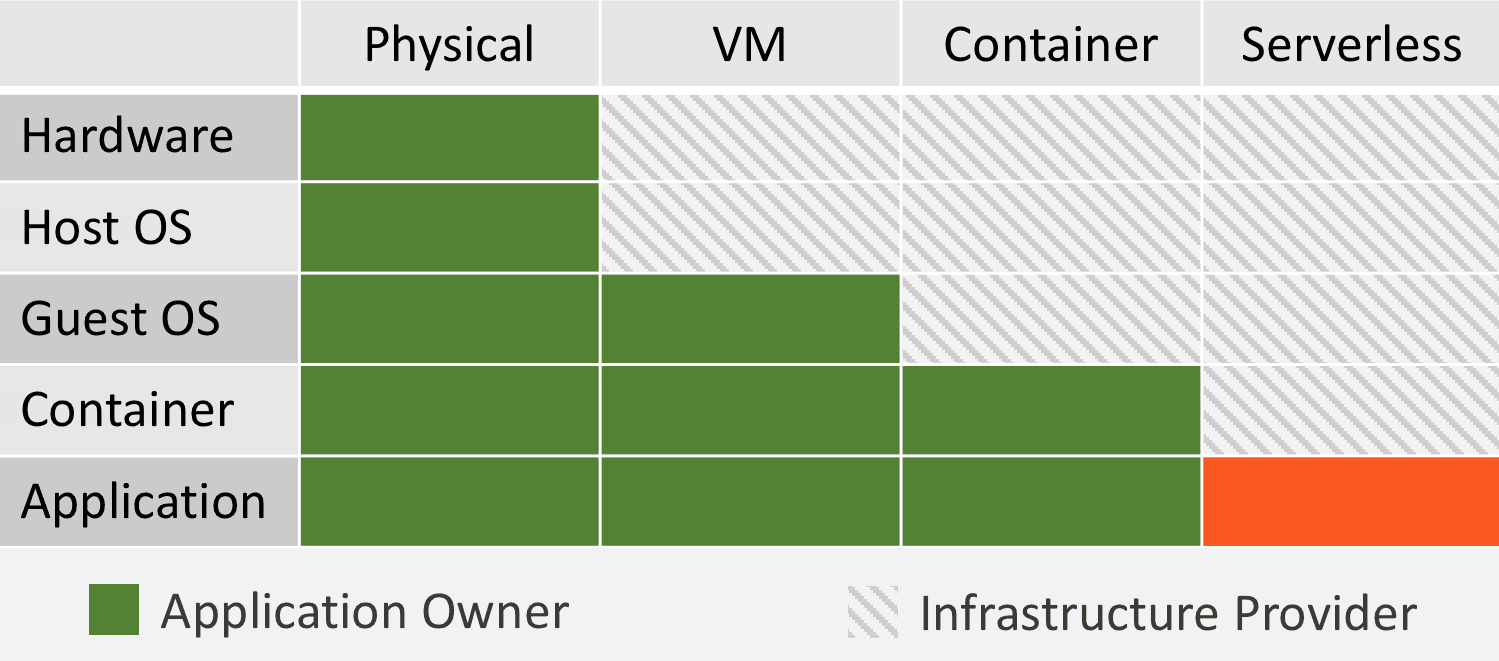
But there is also one key difference between the first 3 infrastructure types and serverless. The first three were building upon each other and were compatible. This means that an application that runs on physical infrastructure can also run on VMs and containers. However, that same application can't run on serverless infrastructure.
Serverless infrastructure requires that the application is specifically architected and coded for such an environment. This makes adopting serverless extremely difficult for existing solutions that just want to change their underlying infrastructure.
You might say, "but I'm building a brand new application". True, but if you haven't built a serverless application before, all the experience you have fits into the green boxes, and not in the red ones. It means you will need to learn a lot of new stuff.
A
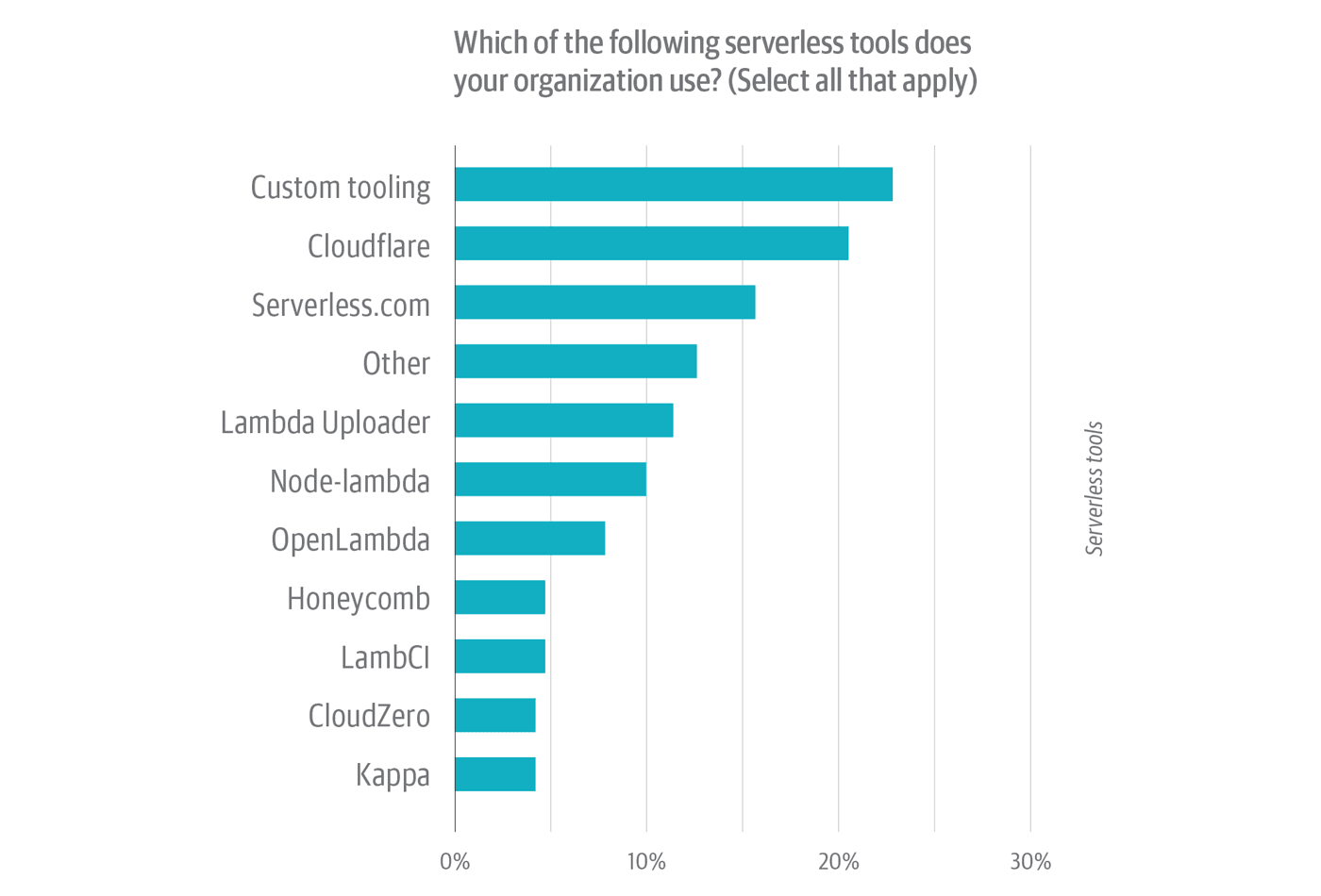
O'Reilly - Why Organizations Are Adopting or Avoiding Serverless
What this means in practice is that building serverless applications can come at a much higher cost. The cost of this custom tooling approach can in fact be so significant that it can eliminate all the savings from switching to a serverless approach. And for this reason, many organizations have decided to delay their migration to serverless.
So is there a way around these serverless challenges?
Webiny is a suite of open-source solutions that consists of a
The framework is specifically created for building applications on top of the serverless infrastructure. It solves all the serverless complexities and challenges, it's fully documented and contains all the libraries you might need to build your serverless application. It enables your team to build serverless solutions in a standardized approach, which makes it easy to learn and understand. Your team will immediately be able to focus on your business logic, and zero time will be wasted on battling serverless complexities.
The framework comes with a GraphQL API, Admin UI, ACL, CLI for deployment and scaffolding, IaC support, and much more. Today it supports AWS cloud, but in the future, support for additional clouds will be added.
The Serverless CMS uses Lambda functions, API Gateway, DynamoDB, and S3. It's built using the Webiny framework. It scales automatically together with the demand, requires zero maintenance, and costs a fraction when compared to solutions running on virtual machines. It includes a headless CMS with a GraphQL API, asset management, and a no-code builder for static pages and forms. It takes 2 commands to install and configure the whole thing. For SaaS and multi-website requirements, there is multi-tenancy that's built-in.
As one of the co-founders of the project, I've been building and dealing with serverless infrastructures for the past few years. I have talked to over 200 companies that have struggled with adopting serverless, or are planning to adopt it, but don't know where to start. We have built Webiny and made it
Give it a try and let us know what you think: