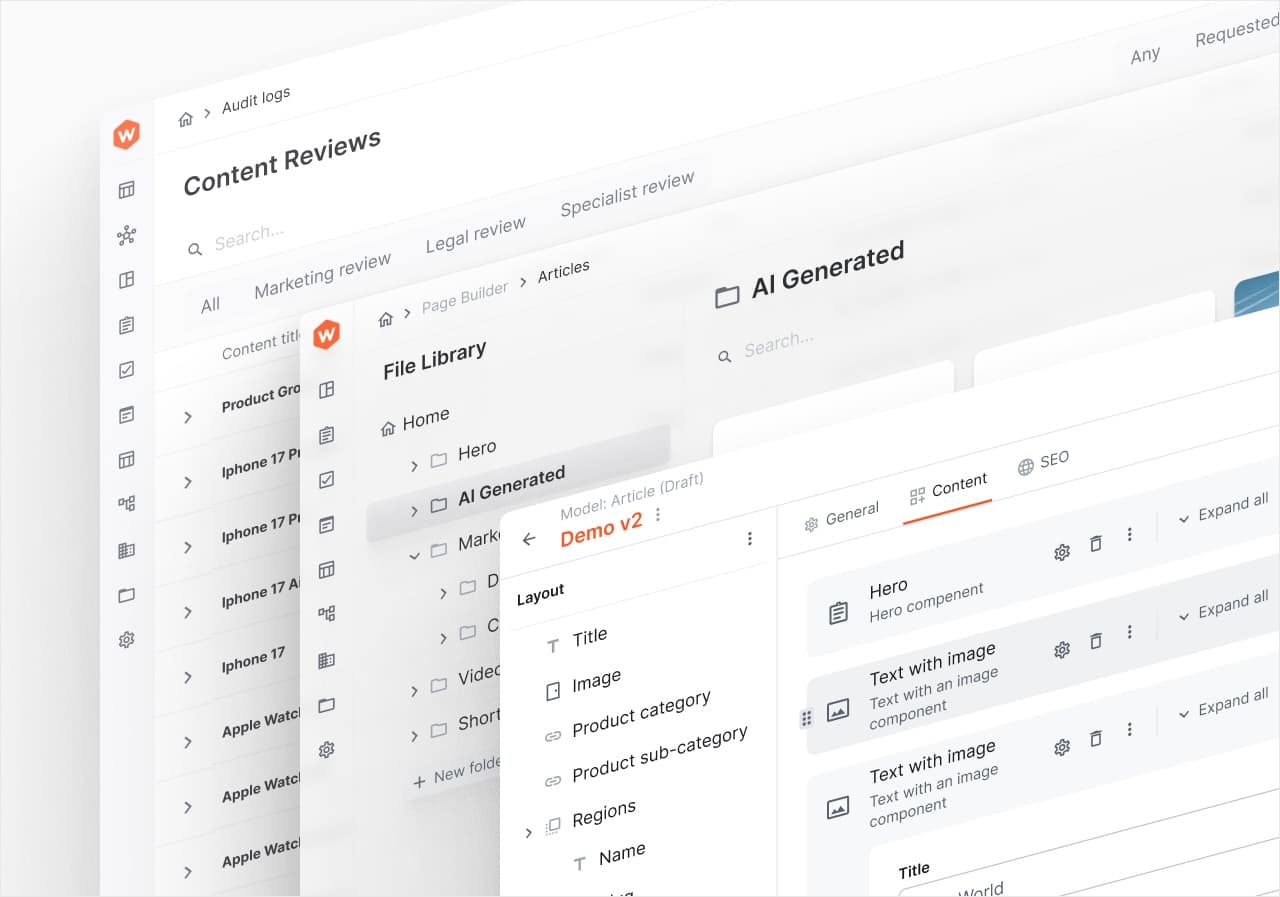
If you're searching for a Contentful alternative, Webiny is the strongest option on the market. It's built for teams that need self-hosted infrastructure, real multi-tenancy, and governance defined in code, not a SaaS-only platform with someone else's constraints built in. This post walks through exactly where Contentful's architecture reaches its limits, and why more engineering teams are moving to a platform they can fully own.
Where the Architecture Starts to Strain
Both platforms are quick to set up and well documented. The friction with Contentful shows up once you're running more than one brand, region, or business unit through the same platform.a
Contentful organizes content into "spaces," which function as separate databases. Each space holds its own content types, entries, assets, and API keys. For multi-brand or multi-region operations, Contentful's own documentation recommends a horizontal scaling pattern: one global space plus separate spaces per brand or market, connected through cross-space references.
That pattern works, but it has documented gaps. Developers using cross-space references have found that linked content doesn't support custom views built with Contentful's App Framework, which limits how much editorial tooling you can extend across brands. And teams building space-per-brand architectures have had to manually manage multiple client instances in their own code, because Contentful's own SDKs don't treat "which space am I querying" as a first-class parameter. In other words, multi-tenancy is something you build on top of Contentful, not something the platform gives you natively.
There are also hard technical ceilings worth knowing about: 1,000 content types per environment, 5 million records per space, and 151 environments per space. Most plans include far less than these ceilings out of the box. And the Content Management API is rate-limited to 10 requests per second per space on paid plans, which becomes a real bottleneck during bulk migrations or CI/CD-driven content operations.
The Vendor Lock-In Question Just Got More Concrete
Vendor lock-in used to be a somewhat abstract argument in these comparisons. It isn't anymore.
On June 1, 2026, Salesforce announced a definitive agreement to acquire Contentful, with the deal expected to close in the third quarter of Salesforce's 2027 fiscal year, pending regulatory approval. Salesforce has said Contentful will become the content layer for its Customer 360 and Agentforce stack.
That's a meaningful shift for any team evaluating Contentful today. If you're already committed to Salesforce, tighter integration with Agentforce could be a genuine upside. If you're not, you're choosing a proprietary SaaS platform whose product direction will increasingly follow Salesforce's roadmap rather than a general-purpose content strategy. It's worth factoring in either way, and it's a fair reason to weigh a self-hosted, independent alternative more seriously than you might have a year ago.
Cost Comparison
Contentful's current published plans are Free, Lite, and a custom Premium or Enterprise tier. Free is capped at 100,000 API calls and 50 GB of bandwidth per month, and it's restricted to non-commercial use. Lite runs about $300 per month for 1 million API calls and 100 GB of bandwidth, with overages billed at $5 per additional million calls. Premium and Enterprise pricing is custom-quoted; third-party procurement data from real customer contracts puts typical enterprise spend around $179,000 per year [figure from Spendhound's aggregated, de-identified customer data, not an official Contentful list price].
Webiny's pricing works differently because you're paying for a license plus your own AWS hosting rather than a per-call SaaS subscription. At smaller project sizes, that structure runs close to Contentful's Lite tier. At medium and large scale, where Contentful's usage-based billing and custom enterprise contracts start compounding, the gap widens considerably. If you want exact numbers for your project size, Webiny's cost calculator runs the comparison directly.
How Webiny Handles Multi-Tenancy Differently
Webiny was built with multi-tenancy as a core architectural decision rather than a pattern layered on top later. One deployment can serve thousands of isolated tenants, brands, or client accounts, each with its own users, content, permissions, and workflows, while sharing the same underlying infrastructure.
Governance is programmable rather than plan-gated. Content models, publishing workflows, and approval chains are defined in code, versioned in Git, and deployed through your normal CI/CD pipeline. Lifecycle events give you before-and-after hooks on every content operation, so you can enforce business rules or trigger automations without waiting on webhooks or middleware.
And because Webiny is open source and self-hosted in your own AWS account, you control networking, data residency, backups, and scaling policies directly. There's no vendor roadmap risk to plan around, because there's no vendor sitting between your organization and its infrastructure.
A Concrete Scenario: One Platform, Many Storefronts
Picture a retail brand running 12 regional storefronts. Each one needs its own promotions, language, and approval chain, but all of them share a global product catalog and brand guidelines.
On Contentful, that setup typically means a global space for shared assets, plus a separate space per region, stitched together with cross-space references. Each new region means provisioning another space, another set of API keys, and more custom tooling to keep roles and permissions consistent across all of them.
On Webiny, that same setup is one deployment with 12 tenants. Each regional team gets its own users, permissions, and publishing workflow. Corporate keeps a single view across all 12, with shared content models and brand guidelines inherited by default and overridden only where a region explicitly needs to diverge. Adding a 13th storefront doesn't mean provisioning new infrastructure. It means adding a tenant.
Developers Get AI Too
Most CMS platforms use AI to help editors write faster. Webiny goes further and lets developers use AI to build on the platform itself.
Describe a feature through the Webiny MCP Server, and it generates production-ready code that follows your project's existing patterns and respects your permission structure. Instead of scoping a custom integration from scratch, your team builds on a foundation that already understands multi-tenancy, workflows, and governance.
Editors get AI too. Whole pages, translations, image tagging, and on-brand copy generation run inside the same platform, tuned to writer and reader personas you define. The difference is that Webiny doesn't stop at the editor. The same AI-programmable foundation extends into the codebase your engineering team actually owns.
Feature Comparison
| Webiny | Contentful | |
|---|---|---|
| Content management | ✅ Included | ✅ Included |
| Visual page building | ✅ Included | ✅ Included |
| Asset management | ✅ Included | ✅ Included |
| True multi-tenancy in one instance | ✅ Built-in | ➖ Separate spaces |
| Content inheritance between brands | ✅ Customizable via code | ➖ Limited support |
| Workflow customization | ✅ Fully programmable | ➖ Limited, plan dependant |
| Lifecycle events | ✅ Full access | ➖ Limited |
| Infrastructure ownership | ✅ Fully control | ➖ Vendor-managed |
| Self-hosted in your cloud | ✅ Yes | ❌ SaaS only |
| No vendor lock-in | ✅ Open-source | ❌ Proprietary |
Where Contentful Still Fits
Contentful can still make sense for a single brand running one site with a small team that doesn't want to manage infrastructure. Outside that narrow case, once you're running multiple brands or regions, need infrastructure you control, or want a roadmap that isn't set by a much larger company's acquisition strategy, Webiny is built for exactly that.
Choose Based on Your Structure
Choose Contentful if you run a single brand, want a fully managed SaaS platform, and your team would rather not own infrastructure at all.
Choose Webiny if you're managing multiple brands or regions from one platform, need governance and workflows defined in code, or want to keep your content infrastructure inside your own cloud account with no dependency on another vendor's acquisition roadmap.
Frequently Asked Questions
Is Contentful being acquired?
Yes. Salesforce signed a definitive agreement to acquire Contentful on June 1, 2026. The deal is expected to close in Salesforce's fiscal Q3 2027, subject to regulatory approval, and Contentful will become part of Salesforce's Agentforce and Customer 360 stack.
Can Contentful handle multi-brand or multi-tenant setups?
It can, through a pattern of separate "spaces" connected by cross-space references, but this isn't native multi-tenancy. Teams have run into gaps around custom editorial views and SDK support for querying across spaces.
Is Webiny actually cheaper than Contentful?
At smaller project sizes, costs are comparable. At medium and large scale, Webiny's license-plus-hosting model tends to come out lower than Contentful's usage-based billing and custom enterprise contracts, though the exact gap depends on your traffic and team size. Use Webiny's cost calculator for numbers specific to your project.
Does Webiny require managing our own infrastructure?
Webiny deploys into your own AWS account using Infrastructure-as-Code, or Webiny can manage it for you. Either way, you own the infrastructure rather than depending on a third-party SaaS environment.
What does migrating from Contentful to Webiny involve?
In practice, it means exporting content types and entries through Contentful's API, mapping them to Webiny's content model, and rebuilding any cross-space reference logic as native tenant relationships. Since Webiny's APIs follow familiar REST and GraphQL patterns, most teams treat this as a scoped engineering project rather than a full rebuild, though the timeline depends on how much custom logic sits on top of your current Contentful setup.
If you're weighing whether Webiny fits your architecture, talk to an engineer and walk through your specific setup.